
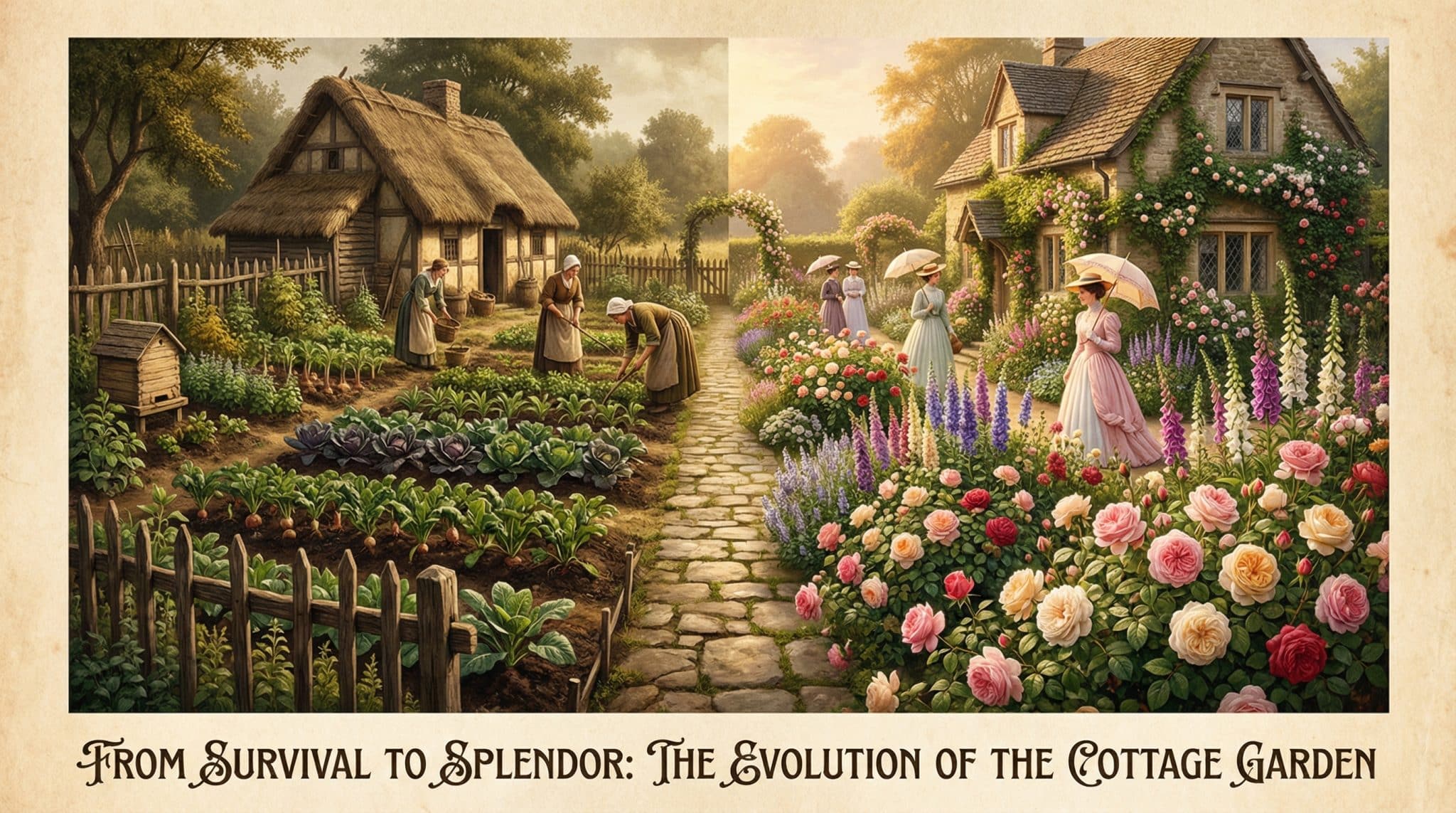
If you picture a “cottage garden” as a rosy little dreamscape hollyhocks waving politely, a thatched roof glowing in golden hour light, everything blooming like it’s auditioning for a calendar yeah… that version is basically the Instagram filter of history.
The real cottage garden started as a working plot. A tiny, jam packed, use every inch or go hungry kind of situation. Beauty happened, sure, but it was the happy side effect like when you throw your hair in a claw clip because you’re late and someone goes, “Wait, that’s cute.”
Beauty was the bonus, not the job.
The “Romantic” Cottage Garden Was… Kind of a Lie (Sorry)
Victorian painters absolutely did us dirty. They gave us this soft focus fantasy where poor cottagers apparently spent their days lovingly arranging delphiniums instead of, you know, trying to survive.
Those paintings weren’t documentary evidence. They were vibes.
Real cottage gardens were basically outdoor pantries + medicine cabinets + “please don’t let the goat eat everything” zones. Plants earned their keep:
- Calendula for salves and healing
- Lavender to cover household smells (because life was… fragrant)
- Roses for hips (hello, vitamin C)
- Herbs near paths because you actually use them (revolutionary concept: put the scissors where you cut stuff)
And those “charming” fences and hedges? Tools. They kept animals in/out, marked space, held up climbers, blocked wind, and did a lot more than stand there looking pretty for Pinterest.
The Black Death: Horrific… and Also Part of This Story
Okay, this part is not in the teacup and scones version of cottage garden history, but it matters.
After the Black Death in the 1340s, there was a massive labor shortage. Survivors had more bargaining power, and in some places that meant access to small plots of land enough to grow food and stay alive. These gardens weren’t designed. They were life support systems.
Vegetables, fruit, medicinal herbs, maybe a beehive if you were lucky, sometimes animals sharing the same cramped space. Flowers showed up when they were useful not because someone wanted a “soft cottage palette.”
By the late 1600s, cottage gardens were common enough that a guy named John Worlidge wrote (in 1677) that there was scarcely a cottage in parts of southern England without a garden. Not a “decorative border.” A garden the kind that fed people and supported the community during “nuptials, feasts, and funerals.”
In other words: cottage gardens weren’t “cute.” They were clever.
Then Rich People “Discovered” Them (As One Does)
Cottage gardens didn’t waltz up the social ladder on their own. They got “discovered,” which is history speak for: someone wealthy decided a working class survival strategy was charming.
By the early 1700s, tastemakers were already tired of super formal, geometric gardens and started praising “simplicity” and “nature” (which is hilarious, because it was still highly curated nature just in a different outfit).
Then along came John Claudius Loudon, who in 1824 basically made the cottage garden “official” by writing about it like a category. And honestly, the best part is that he documented the logic:
- scent by the door (because you walk past it a hundred times)
- parsley along paths (because you grab it constantly)
- climbers near ugly/smelly bits (because you don’t want to stare at the pigsty, do you?)
It’s the original “make your house work for you” mindset, just with more mud.
There’s also a slightly darker layer here: some Victorian reformers promoted cottage gardens as a way to keep workers “stable” and “productive” (read: less likely to riot). So yes, sometimes “help” came with a side of social control. History is messy like that kind of like my potting bench in April.
Arts & Crafts Took the Mess and Made It a Movement
Fast forward to the late 1800s/early 1900s and the Arts and Crafts crowd basically said, “This vibe? We’re keeping it forever.”
- William Morris loved the honest, abundant look as a middle finger to industrial sameness.
- William Robinson pushed “wild garden” planting less forcing plants into stiff patterns, more letting them behave like plants. (The gardening equivalent of finally buying pants with an elastic waistband and calling it “a lifestyle.”)
- Gertrude Jekyll brought serious color theory and structure, taking the accidental mixes from working gardens and turning them into something intentional and repeatable.
Which is how we ended up with the cottage garden as we think of it now: lush and “natural,” but secretly planned.
The Only Cottage Garden “Rules” I Actually Want You to Follow
I’m not here to hand you a clipboard and whistle. But if you want that cozy, abundant cottage feel without your yard turning into a thunderdome these are the principles that do the heavy lifting.
1) Plant Like You Mean It (Aka: Don’t Leave Big Sad Empty Gaps)
Cottage gardens came from tiny plots. Bare soil wasn’t decorative. It was wasted space. Plant a little tighter than you think you should (within reason don’t start a fungal convention).
Modern translation: it will look sparse in spring. Don’t panic. By midsummer, it’ll knit together into that lush “tumble” everyone loves.
2) Mix Pretty With Useful (Because Why Not?)
The whole point was: if a plant can feed you, heal you, bring pollinators, or reseed itself… it’s invited with easy care cottage plants in mind. If it’s only there to look cute, it better be real cute.
My favorite combo is sneaking edibles into “flower beds” like a tiny act of rebellion:
- chives that bloom purple and pretend they’re ornamental
- bronze fennel for height (and snacks)
- calendula everywhere because it’s cheerful and hardworking
If a plant can be pretty and pull its weight, it’s hired.
3) Go Vertical (Your Garden Has a Third Dimension, Use It)
Cottage gardens aren’t just ground level chaos. They’re layered: low growers, mid height perennials, tall anchors, and climbers doing the most.
Add something that climbs roses, clematis, beans, whatever suits your space. A trellis or fence instantly makes things feel cottage-y, even if the rest of your garden is still… “in progress.”
4) Let Things Self-Sow (But Don’t Let Them Take Over the Mortgage)
Self-seeding is part of the magic. It’s how you get that relaxed, unforced look that’s hard to fake.
But and I say this as someone who once let one “cute little volunteer” turn into a whole neighborhood you’re still in charge. Pull what you don’t want. Transplant what you do. Edit like a friendly but firm manager.
Let them reseed a little… just don’t hand them the deed.
5) Give the Chaos Some Bones (Paths, Edges, Structure)
Here’s the secret sauce: cottage gardens look charming because there’s structure underneath holding it all together.
Paths, edging, hedges, fences, walls anything that says, “Yes, it’s abundant, but I didn’t just fall out of a seed packet.”
Skip the structure and you go from “romantic overflow” to “where did the path go?” in about six weeks.
Want to See the Dream in Real Life? Go Visit the Masters
If you ever get the chance to visit historic English gardens, do it. Photos are cute, but standing in a real garden teaches you things your screen never will like how much structure is hiding under that “effortless” look.
A few big names (the garden equivalent of celebrities):
- Sissinghurst (Kent): garden rooms, strong bones, and that iconic “controlled mess” energy
- East Lambrook Manor (Somerset): Margery Fish proving cottage gardening can feel intimate and doable (even if two acres still sounds like… a lot)
- Hidcote (Gloucestershire): more garden rooms and smart organization
- Hill Top (Lake District): Beatrix Potter’s place sweet, grounded, and tied to real cottage life
Also worth knowing: the cottage garden style didn’t glide through history uninterrupted. After WWII, lawns and modernism took over, and cottage gardens got filed under “nostalgia.” The version we plant today is often a choice a revival. But honestly? I love that. It means you’re picking abundance on purpose.
Why This Style Still Has Us in a Chokehold
Cottage gardens stick around because they answer real human needs: make something beautiful, make something useful, create a little sanctuary, and do it without needing a perfectly manicured estate (or a full time gardener named Nigel).
So if you’ve been staring at your yard thinking, “I want it to feel alive, but I also don’t want to babysit it,” cottage gardening might be your people.
Plant it full. Mix the practical with the pretty through storybook cottage garden ideas. Add a trellis. Leave a little room for surprise. Keep a path so you can actually walk through it.
Now go plant something useful and let it be gorgeous on the side.