
You know that garden arch you bought because it looked so charming online… and now it’s just sitting there in your yard like a sad metal rectangle? Yeah. Same.
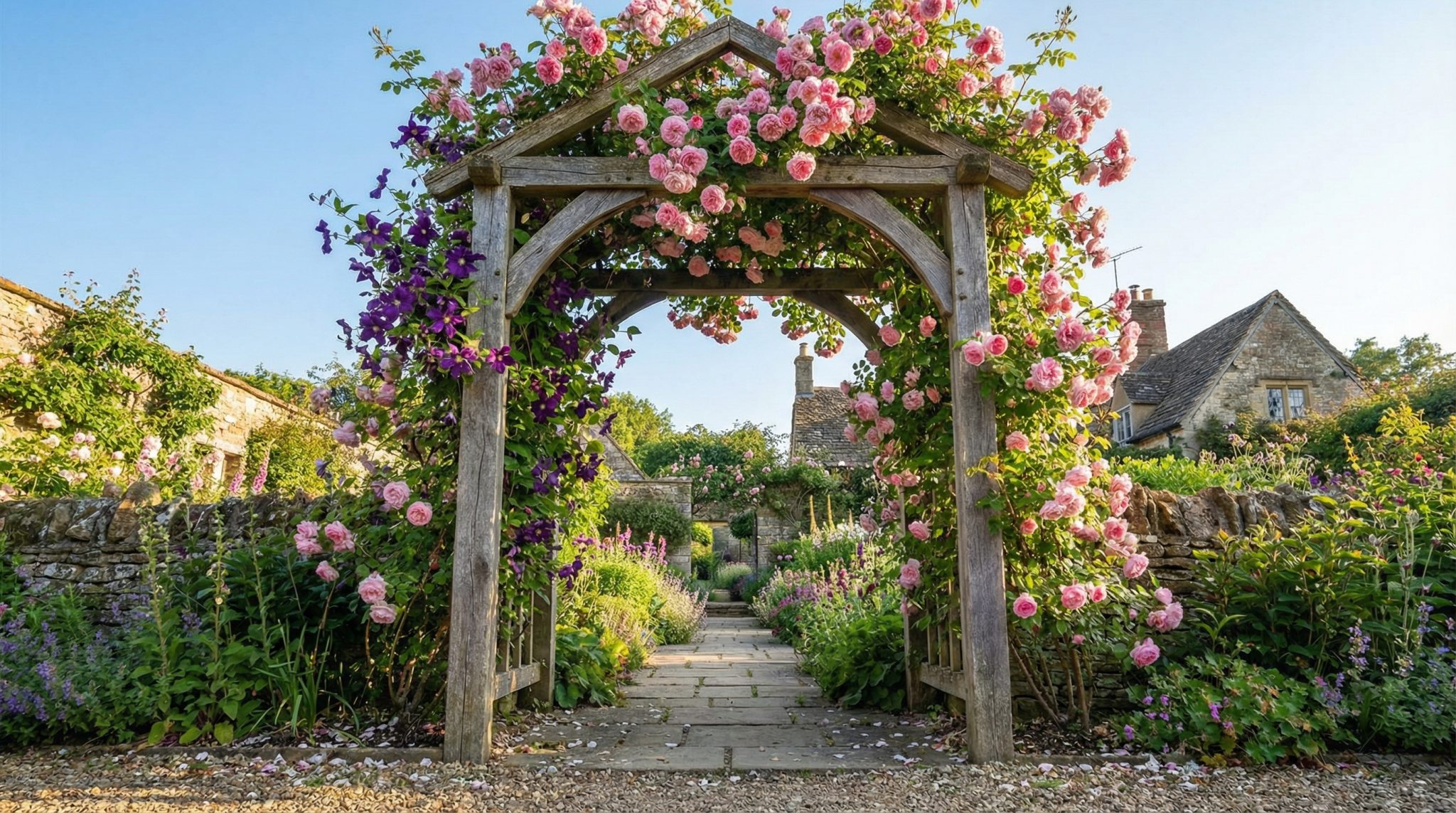
The good news: one good climbing plant can turn that thing into a full on “walk through here like you’re entering a secret garden” moment.
The bad news: the wrong climbing plant can bend your arch into a modern art sculpture, give you eight feet of bare sticks with flowers only at the top, or straight up eat your fence. (Ask me how I know. I have made mistakes so you don’t have to.)
So let’s pick something that actually works for your arch, your sunlight, and this is important your real life energy level (not the fantasy version of you who prunes in linen overalls at sunrise).
Step one: go outside and shake your arch (seriously)
Before you fall in love with a vine, do a quick reality check:
- Give the arch a wobble test. If it does the cha cha when you touch it, it does not get a heavyweight vine. Lightweight climbers only, or you’re basically installing a plant powered demolition project.
- Check the light. Full sun? Part shade? Deep shade where even optimism struggles? This matters more than people like to admit.
- Decide what you want most:
- fast coverage
- fragrance
- flowers for months
- shade tolerance
- “I will do almost no maintenance, thank you”
Because the right vine is basically a good roommate. The wrong one is the roommate who “borrows” your car and brings it back on fumes.
The secret to easy success: how your vine climbs
This sounds nerdy, but it’s the difference between “low effort glow up” and “why am I outside with plant tape again?”
Here are the main types:
- Twining vines (honeysuckle, jasmine, wisteria): they wrap around supports as they grow. You usually just need to get them started in the right direction and they’ll take it from there.
- Tendril climbers (clematis, sweet peas): they grab with skinny little tendrils. They need something they can actually hold, like wire/mesh with smaller openings (think ½”-1″). A thick pole is like trying to hug a tree with a rubber band.
- Scramblers (climbing roses): they don’t truly “climb.” They sprawl and lean and need you to tie them in. Gorgeous, yes. Independent, no.
- Self-clingers (climbing hydrangea): they attach with little rootlets/pads. Amazing on masonry… but they can damage weak mortar, painted wood, and some siding. So maybe don’t let them freestyle on your house unless you’re cool with consequences.
My favorite climbing plants for arches (with real talk included)
1) Honeysuckle: easiest win + insane scent
If you want fragrance without a ton of fuss, honeysuckle is my go to suggestion.
- Why it’s great: twines on its own, tolerates sun and shade, smells incredible in the evening.
- How fast: once established, you’ll usually see solid yearly growth, and an arch can be covered in a couple seasons.
- Important warning: skip Japanese honeysuckle (invasive in a lot of eastern North America). Look for trumpet honeysuckle or named cultivars that behave better.
This is the vine for people who want their yard to smell like it’s wearing perfume… but don’t want a second job.
2) Clematis: the cottage garden classic (with one dramatic requirement)
Clematis is that plant that makes you feel like you should start saving dreamy cottage garden ideas and using the phrase “perennial border.”
- Why it’s great: huge variety, tons of bloom colors, looks amazing on arches.
- My basic clematis rule: sun on top, cool roots.
Mulch 3-4 inches, or plant something low in front of it so the base stays shaded. (Clematis likes a sun hat and cool shoes. Same.) - Pruning without spiraling: check the tag for the pruning group.
- Group 3 (like ‘Jackmanii’) is easiest: cut it back hard in early spring, it blooms on new growth.
- Group 1 and 2 get fussier. (Guessing is a fun hobby until you’re holding pruning shears.)
- Planting tip: set it a couple inches deeper than it was in the pot.
If you want “pretty but not precious,” clematis is a solid pick especially on lighter arches.
3) Climbing roses: stunning, but you’re signing up for training
Roses over an arch are basically the rom com of gardens. Dreamy. Classic. Occasionally high maintenance.
- Good options: ‘New Dawn’ is dependable, repeat blooming, and pretty forgiving. ‘Zephirine Drouhin’ is famously low on thorns (your forearms will thank you).
- The #1 mistake: training the canes straight up.
You get bare stems at eye level and flowers only at the top, like a weird floral hat.
Instead: train your main canes horizontally or at about a 45 degree angle. That encourages side shoots, and side shoots = flowers all the way up.
Roses are “scramblers,” so yes, you’ll be tying. But if you want that storybook arch moment? Worth it.
4) Climbing hydrangea: the shade hero (and the patience test)
Got an arch in shade or on the north side where other flowering vines sulk? Climbing hydrangea is your best bet.
- Why it’s great: shade tolerant, beautiful white blooms, low maintenance once established.
- The catch: it’s slow at first. Like… rude slow.
It may do almost nothing above ground for 2-3 years because it’s building roots. It’s not dead. It’s plotting. - How it attaches: self-clinging. Great on rough surfaces. On a freestanding arch, it often needs mesh or a rough panel and a few ties early on.
If you can be patient, it becomes one of those “how is this so gorgeous?” plants later.
5) Wisteria: breathtaking drama, big commitment
Wisteria is the plant equivalent of a chandelier: stunning, heavy, and not for flimsy ceilings.
- Support requirement: you need something seriously sturdy. Wisteria gets heavy. If you put it on a lightweight arch, the plant will win that argument.
- Maintenance: pruning is not optional if you want flowers and sanity.
- Please don’t plant the bullies: skip Chinese/Japanese wisteria in many regions they can be aggressive and hard to contain.
American wisteria (like ‘Amethyst Falls’) is a better behaved option.
Also: seed grown wisteria can take years to bloom. If you want flowers sooner, buy a plant that’s been propagated from cuttings.
Wisteria is for sturdy pergolas, patient gardeners, and people who are okay saying, “Yes, I prune twice a year.”
6) Star jasmine: warm climate dreamboat
If you live where winters stay mild, star jasmine is a gorgeous evergreen-ish option with sweet white blooms and strong evening fragrance.
Just check your hardiness zone hard freezes and jasmine are not friends.
Put it near a patio or seating area and you’ll feel extremely smug every summer evening.
Need your arch to look good this year? Annual vines to the rescue
Perennial vines are a long game. If you want your arch to stop looking naked by July, annuals are your fast pass.
- Morning glory: ridiculously fast, minimal care, tons of color. (Check local guidance some types self-seed enthusiastically.)
- Purple bell vine: fast coverage and moody dark flowers. Looks especially good with silver foliage nearby.
- Sweet peas: the best scent, hands down, but they like cooler conditions and they want you to deadhead regularly. (They’re high maintenance in a “but I’m worth it” way.)
- Black eyed Susan vine: cheerful orange blooms, great for smaller arches and containers.
Annuals are also fantastic while you wait for a slow perennial (looking at you, climbing hydrangea) to wake up and choose violence.
Quick “pick your vine” cheat sheet (because you’re busy)
If you’re standing in the garden center feeling personally attacked by all the options, easy-care cottage plant picks:
- I want low maintenance + fragrance: honeysuckle
- I want classic cottage vibes: clematis (or clematis + rose if you’re feeling ambitious)
- I want shade tolerance: climbing hydrangea
- I want fast coverage this season: morning glory, purple bell vine, black eyed Susan vine
- My arch is lightweight/decorative: clematis or annuals (don’t put wisteria on there unless you hate your arch)
- I have a beefy pergola and patience: American wisteria
Planting + training (the part everyone rushes, then regrets)
Here’s my hill to die on: support first, plant second.
Trying to add trellis wires later is like trying to put on socks after your shoes are tied.
A few basics that save headaches:
- Dig wider than you think (about 1.5x the root ball width).
- Water deeply in year one. A sprinkle is not watering. It’s just making the soil smell nice.
- Mulch, but don’t pile it against the stem. Leave a little breathing room so it doesn’t rot.
- Don’t plant right up against a wall. Soil there stays dry. Plant about a foot out and angle stems back toward the support.
Training tip that fixes 80% of “bare at the bottom” problems:
Start by weaving a few stems sideways (horizontal or 45 degrees). Side growth = more blooms = less sadness.
And please check your ties occasionally. A tie that’s “soft” in May can strangle a thickened stem by September. (Your plant will not send you a calendar reminder. I wish.)
Common mistakes (so you don’t have to learn the hard way)
- Under watering the first year. Deep watering builds deep roots. Deep roots make tough plants.
- Choosing a vine that outmuscles your arch. Your arch is not “training up” to handle wisteria.
- Planting invasives without realizing it. Do a quick search for your region before buying honeysuckle or wisteria.
- Forgetting ties exist until everything flops. A little guidance early saves a lot of wrestling later.
- Expecting instant results from perennials. Most sleep, creep, then leap. (Yes, it’s annoying. Yes, it’s normal.)
Go make that arch earn its keep
A good climbing plant turns an arch from “random yard thing” into an actual moment shade, scent, flowers, the whole deal. Pick a vine that matches your sunlight, your structure’s strength, and your willingness to fuss with it.
Then plant it, train it sideways a bit, water it like you mean it… and let your arch become the main character.
Now go outside and give that arch a shake. It’s time to choose its destiny.