
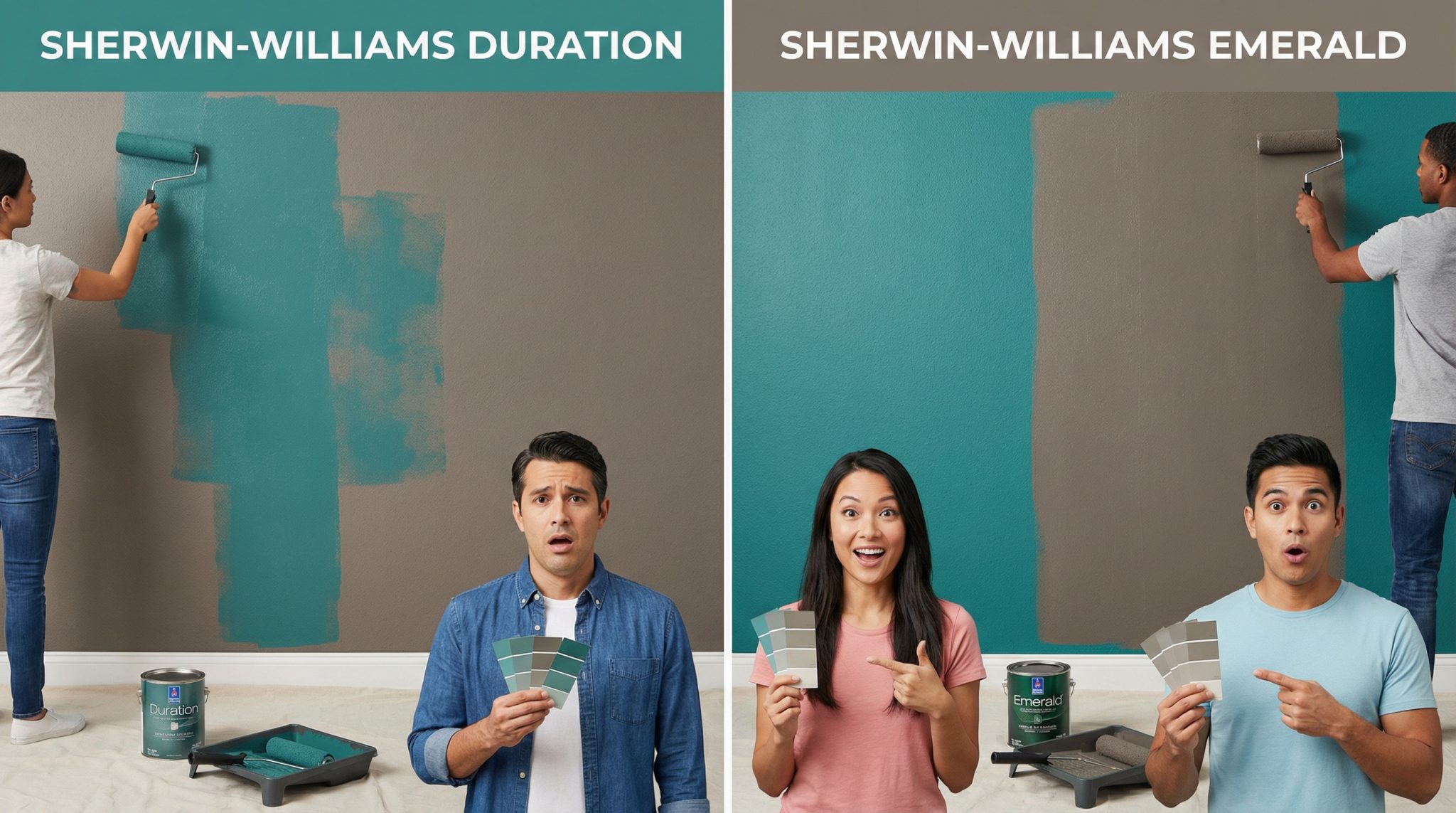
If you’ve been standing in the Sherwin-Williams aisle (or tab hoarding online) trying to figure out why Duration and Emerald cost basically the same but everyone swears their favorite is “the best,” welcome. This is one of those mildly annoying adult mysteries, like why fitted sheets can’t just behave.
Here’s the truth: these are both great paints. You’re not choosing between “good” and “trash.” You’re choosing between two overachievers with different superpowers.
My quick, slightly bossy mantra is: pick the paint for the pain.
Not the price tag. Not the marketing copy. The pain.
The 10 second version (for tired people with decision fatigue)
Ask yourself which of these is the bigger threat in your house:
- Will you be wiping/scrubbing the walls a lot?
Think: kitchen grease, kid fingerprints, the mysterious smudge that appears next to the light switch like it pays rent.
→ Pick Emerald. - Will the walls get scuffed/bumped constantly?
Think: hallways, staircases, furniture corners, backpacks sliding down the wall in slow motion.
→ Pick Duration. - Is the room damp or poorly ventilated?
Think: steamy bathroom with no fan, basement that gives “vampire lounge” vibes, laundry room humidity swings.
→ Lean Duration.
If your answers conflict (because of course they do), choose what happens most often. Weekly scrubbing? Emerald. Daily body checking in the hallway? Duration.
My opinionated “who wins overall” call
For most normal rooms in most normal houses, I’d give the edge to Emerald. It’s more forgiving to apply, it tends to cover better, and it’s lovely when you actually have to clean your walls like a real human.
Duration is my pick when the space is basically a contact sport—hallways, stairs, rentals, basements, damp zones. It’s the tough kid on the playground.
The money part (aka Paint Math, Destroyer of Budgets)
On the shelf, Duration can look a smidge cheaper. But paint is sneaky, and the can price isn’t the whole story—coverage is.
In general:
- Emerald often covers around 300-400 sq ft per gallon
- Duration is often more like 250-300 sq ft per gallon
So on a bigger job, you may buy more gallons of Duration, which can wipe out the “cheaper per gallon” situation real fast.
Also: if you’re painting a deep color (Sherwin Williams navy shade, forest green, etc.), coverage matters even more. I’ve had rooms where one paint felt like it was whispering, “You’re going to need a third coat,” and I could practically hear my wallet whimper.
Translation: the cheaper can isn’t always the cheaper job. Paint economics are rude like that.
What it’s like to actually apply (read before you’re mid wall spiraling)
This is the part nobody talks about until you’re holding a roller at 9:47 p.m., staring at lap marks, and questioning every choice you’ve ever made.
Emerald: the forgiving friend
Emerald is smoother and more self-leveling. Brush marks settle down. Touch ups tend to blend better. It’s generally easier to get that “wow, I did that” finish even if you’re not a professional painter.
Duration: the tough guy with opinions
Duration is thicker. That’s part of why it holds up to scuffs and bumps but it can be less forgiving if your technique is… let’s call it “enthusiastic beginner.”
If you use Duration, do yourself a favor:
- Use a thicker nap roller (around 1/2″ works well for most walls)
- Keep a wet edge (don’t dawdle—this paint likes commitment)
- Clean your tools fast (ask me how I know… I once turned a perfectly good brush into modern sculpture in about ten minutes)
Bottom line: Emerald smooths over your oopsies. Duration likes you to earn it.
“Paint and primer in one” (and other adorable lies)
Both of these paints may claim they’re basically primer too. Sometimes that’s true! Sometimes it is… not.
Use a real primer for deep blue paint if you’re dealing with:
- Water stains or smoke damage
- Big color flips (especially red/blue → white)
- Glossy surfaces you didn’t degloss
- Bare new drywall
Skipping primer in those cases is like putting mascara on before you wash your face. Sure, you can. But you’re not going to like the outcome.
Room by room: where each one shines
Here’s the quick “don’t overthink it” cheat sheet:
Pick Emerald for:
- Kitchens (grease + wipe downs)
- Kids’ rooms (marker “art,” handprints, snack residue… the usual)
- Bedrooms (especially if you want low odor / better air quality)
- Living rooms (generally moderate wear, you want it to stay pretty)
- Well ventilated bathrooms (where humidity isn’t constantly attacking)
Pick Duration for:
- Hallways + staircases (scuffs, bumps, constant rubbing)
- Rentals (shorter repaint cycle + high abuse)
- Basements (damp vibes)
- Laundry rooms (humidity swings)
- Poorly ventilated bathrooms (steam is the enemy here)
And yes, I know in your fantasy life nobody touches the walls. In my real life, someone is always leaning on something they shouldn’t.
If you’re still torn: do the quick and dirty test
If you need proof (I get it), buy a sample of each and paint them on a primed test board. Then—this part matters—let them cure for about a week. Paint needs time to become its final, fully durable self.
After a week:
- Washability test (Emerald’s moment):
Draw on both with marker. Let it sit overnight. Wipe with a damp cloth + mild dish soap. See which cleans easier without getting shiny (burnishing). - Scuff test (Duration’s moment):
Drag a coin edge across both. See which one marks less.
If you skip cure time and declare a winner immediately, I’m not mad. I’m just… disappointed. (Kidding. Mostly.)
My final “just tell me what to buy” answer
- If your main problem is cleaning: Emerald
- If your main problem is scuffs/impact: Duration
- If your room is damp and sad: Duration
- If you want the most DIY friendly, generally great, looks good longer paint for typical rooms: Emerald
Now close the 47 paint comparison tabs, pick the paint for the pain, and go make those walls earn their keep.