
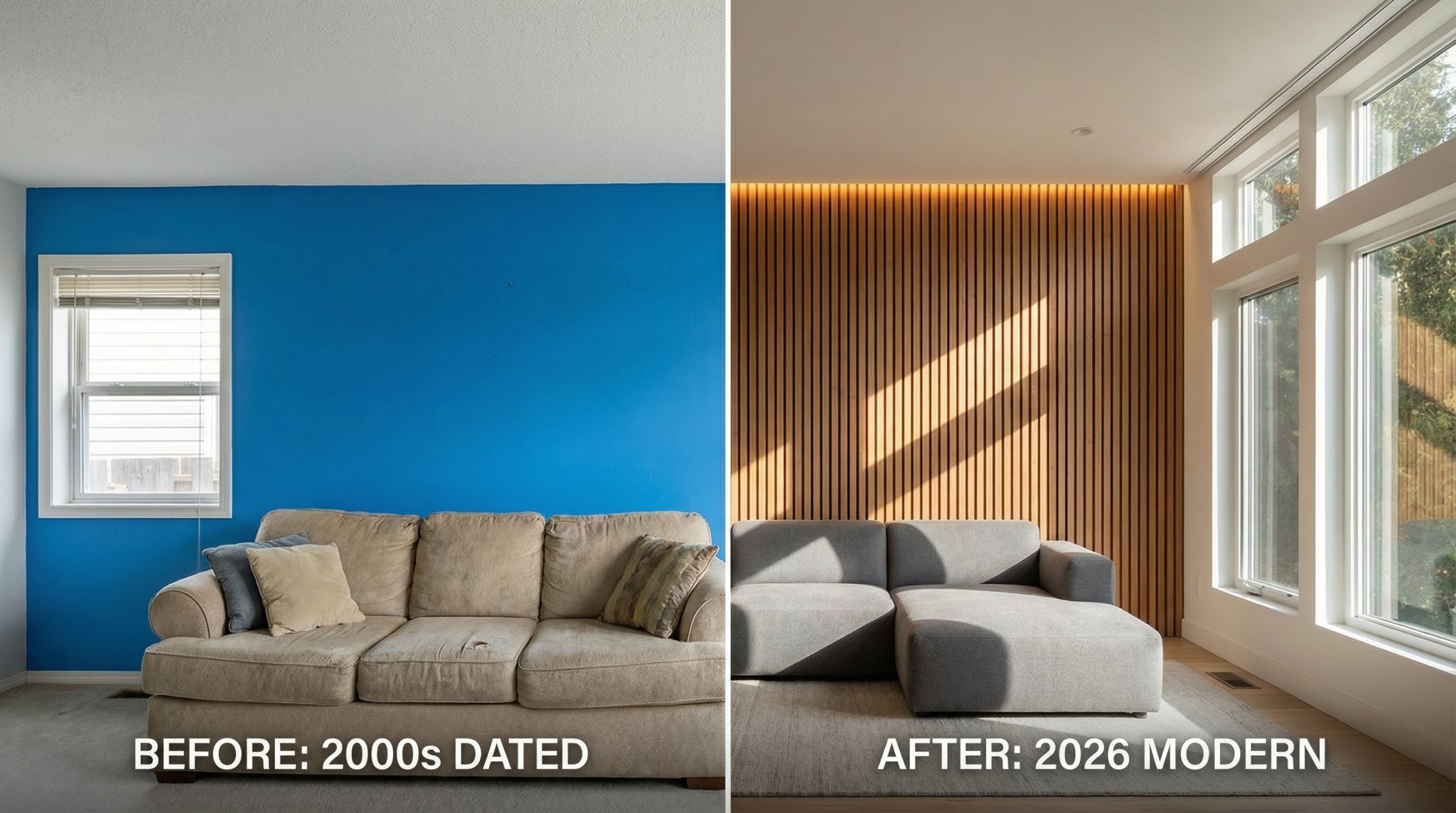

The Secret to Accent Walls That Actually Work (Because the “One Random Red Wall” Era Is Over)
Let me guess: you painted one wall a bold color a few years ago, felt wildly brave for 36 hours, and now it kind of… looks like a design prank you played on yourself.
You’re not alone. The classic “pick a loud color, paint one wall, call it an accent wall” has officially started reading a little dated — not because bold color is bad, but because a lonely, flat wall with no purpose looks like you ran out of steam halfway through the room. (Been there. I once left a “temporary” accent wall up so long it could’ve applied for a driver’s license.)
The good news: accent walls aren’t dead. They just need to be smarter. More intentional. Less “one off statement,” more “this is clearly on purpose.”
Let’s talk about what’s making accent walls look weird lately — and what to do instead.
Why the Basic Accent Wall Feels Off Now
Here’s the problem with the old formula: it’s too easy.
A single bold wall with nothing else going on (no texture, no repeat of the color, no furniture plan that supports it) can look like you were testing paint colors and then got distracted by tacos.
What makes an accent wall look dated:
- Flat paint on a flat wall (no texture, trim, paneling, anything)
- A super saturated color that isn’t echoed anywhere else in the room
- A “random wall” choice (like: why that wall? what did it do to you?)
- No connection to the rest of the space (pillows, art, rug, lighting… hello?)
What makes an accent feel intentional:
- It anchors a zone (bed wall, TV wall, dining nook, office backdrop)
- It has some depth (molding, paneling, limewash, slats, wallpaper)
- The color shows up elsewhere (even subtly)
- It sits where the eye naturally lands, instead of fighting your layout
It’s not “don’t do color.” It’s “don’t do color… stranded on an island.”
My Favorite “Accent Wall” Swaps That Look Way More Expensive
If you want the vibe of an accent wall without that 2014 “feature wall” energy, pick one of these approaches and actually commit to it.
1) Paint the ceiling (yes, I’m serious)
Ceilings are having a moment because your eye reads them as architecture, not “I got bored with white.”
This works especially well in open layouts where you’re trying to define a living area or dining space without building walls like a tiny medieval castle.
Ceiling colors that tend to look amazing:
- Near black (moody, cozy, dramatic)
- Warm earth tones (soft and grounded)
- Deep jewel tones (if you want the room to put on a velvet blazer)
If painting a whole ceiling makes you break out in a stress rash, keep reading — there’s an even easier option.
2) Do an accent door (tiny commitment, huge payoff)
An accent door is my favorite “I want to change something but I’m tired” update.
A closet door in the entry, a pantry door, a hallway door — they’re small surfaces, so you can be bolder without feeling like you moved into a circus.
I’ve painted a door in an afternoon and felt like I renovated the entire house. It’s the DIY equivalent of putting on mascara.
Tip: start with the least emotionally important door in your home. Not the one you stare at during your 2 a.m. life spirals.
3) Add trim or molding so the wall looks “built,” not “painted”
If you want an accent wall that screams “custom,” give it a frame.
Picture frame molding, board and batten, wainscoting — all of these add structure so the wall reads as a design feature, not just a color experiment.
Bonus: trim + paint looks good in almost any style of home, from “historic charm” to “we bought this flip and now we’re undoing it.”
4) Choose texture instead of pattern
If your style is more calm than chaotic, texture is the move.
- Limewash / plaster style finishes = soft, cloudy depth (but technique matters)
- Slatted wood = warm, modern, very “I have my life together” energy
- Paneling (like nickel gap or V groove) = classic with just enough interest
Texture catches light all day, so the wall changes subtly without you having to do anything. (Which is my favorite kind of design.)
5) Wallpaper, but don’t do the sad little single panel
Wallpaper can be gorgeous… or it can look like a staged house from 2009.
What looks current is either:
- A fully committed wallpaper moment (more than one wall, or a whole nook)
- A mural/wraparound effect that feels immersive
- A wallpapered ceiling (for the brave and the dramatic)
What tends to look dated: one wallpaper wall, slapped up like an afterthought, with nothing else supporting it.
The Room by Room Truth (Because Not Every Space Wants an Accent Wall)
Here’s the cheat sheet I’d tell you if we were standing in your house with coffee.
Living room
Skip the random accent wall. If you want impact, do:
- a moody media wall, or
- an accent ceiling to define the space
Bedroom
Accent walls still work here because a bed naturally creates a focal point.
- Best bet: headboard wall with texture (slats, paneling, limewash)
- Or: a soft, cozy ceiling color
Dining room
Dining rooms can handle drama.
- Deep paint + wainscoting? Beautiful.
- Wallpaper with some architectural framing? Also beautiful.
Kitchen
Painted accent walls in kitchens usually feel weird because there’s already so much going on (cabinets, counters, backsplash, appliances…).
- Put color on the island or lower cabinets
- Add interest with a textured backsplash instead
Home office
This is where dark and moody makes practical sense.
- A darker wall behind your desk can look polished on camera and reduce glare
Bathroom
Paint can work, but bathrooms are basically humidity festivals.
- If you’re painting: use the right finish (more on that below)
- Tile and texture usually look more “forever” than paint alone
Hallways + entries
My favorite place to be bold.
Less furniture = less visual chaos = color gets to shine.
- Accent doors, color blocking, playful paint moments… go for it.
Color, But Make It Make Sense
I’m not here to ban bright colors. I’m here to ban bright colors with no friends.
If you go bold, repeat it somewhere with undertone friendly accent colors: a rug thread, a lamp base, art, pillows, a throw. It doesn’t have to be matchy — it just has to feel intentional.
A few better neutral color schemes that are hard to mess up:
- Soft greens (calm, fresh, surprisingly flexible)
- Sunbaked warms (terracotta, clay, golden tones — cozy without being beige-y)
- Restorative darks (inky blue, espresso brown, wine tones — amazing for offices and media walls)
- Smoky neutrals (great if you want depth without the “wow that’s a COLOR” commitment)
What I’d avoid: super bright primary colors on one flat wall with nothing else going on. That’s the look that tends to scream “2012 Pinterest board.”
My 3-Step “Don’t Regret This Later” Plan
If you do nothing else, do this. It saves so much second guessing.
Step 1: Decide what the accent is doing
Pick one job:
- Creating a focal point (bed wall, TV wall)
- Defining a zone (open concept)
- Highlighting an architectural feature (fireplace, built-ins)
If you can’t explain the job, it’s probably a random wall accent. (And random wall accents are the design equivalent of buying another water bottle when you’re avoiding your problems.)
Step 2: Pick ONE depth method
Choose your lane:
- Trim/molding/paneling
- Texture (limewash, slats, plaster-y finishes)
- Wallpaper/wallcovering
Don’t stack five “special” things at once unless you’re going for maximalist on purpose.
Step 3: Choose your palette vibe
Warm, cool, dark, or neutral. Done. No spiraling.
The Testing Rules I Swear By (Because Lighting Is a Liar)
Before you commit, paint a real test patch. Not a tiny one. A big one.
- Paint a sample that’s at least 2-3 feet wide on the actual wall
- Look at it in morning, afternoon, and night lighting
- Give it a day or two to settle before you decide
Also: finish matters.
- Matte looks modern and hides imperfections in most living spaces
- Satin is your friend in bathrooms, kitchens, and anywhere that gets splashed or wiped a lot
- Save semi gloss for trim/doors if you like that crisp look
And if you’re thinking limewash, tall ceilings, heavy texture, or a very dark color that shows every flaw? That’s when hiring help stops being “extra” and starts being “smart.”
Budget Reality (So You Don’t Accidentally Spend $900 to Be Mildly Happier)
Here’s the rough “what makes sense” breakdown:
- Under $100: paint an accent door (high impact, low risk)
- $100-$300: accent ceiling in a small room, or a more intentional color block moment
- $300-$800: wallpaper or simple paneling (big visual payoff)
- $800+: slatted walls, professional limewash/plaster, built out media walls
My rule: pick the biggest change you’re willing to undo in a weekend. If you’re renting or indecisive (hi, welcome), stay in the easy to reverse zone.
The Actual “Secret” to Accent Walls That Work
It’s not the color. It’s not the trend forecast. It’s not even whether you do a wall at all.
It’s this: an accent has to look like it belongs to a plan.
So choose a spot that naturally deserves attention, add depth (texture/trim/wallcovering), and repeat the color or vibe elsewhere in the room so it doesn’t feel stranded.
Pick one room. Pick one approach. Test it in your real lighting. And then commit like you mean it.
Because if you’re going to do an accent, you might as well make it look like you did it on purpose.