
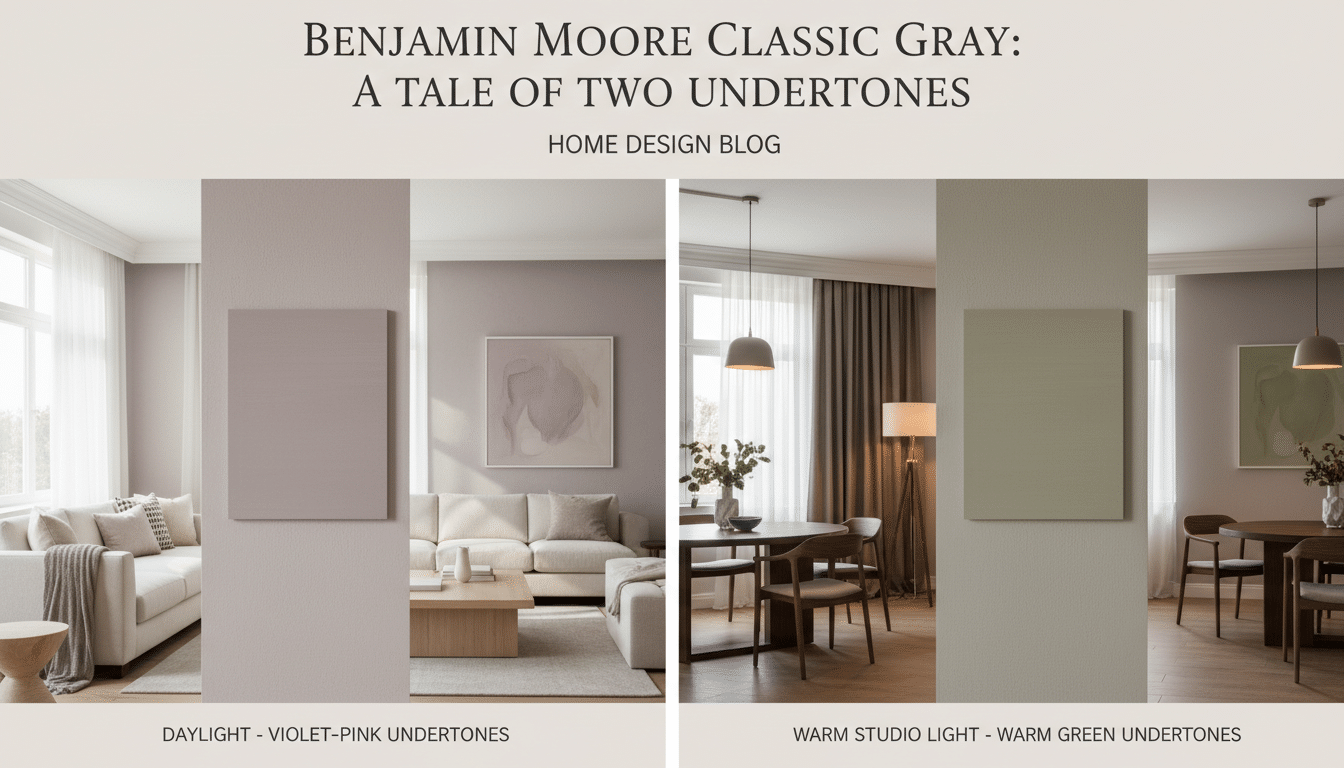

Why Your “Classic Gray” Walls Suddenly Look… Purple (You’re Not Losing It)
If you painted your walls Benjamin Moore Classic Gray and then caught a weird lavender-y flash out of the corner of your eye and thought, “Oh no. I’ve accidentally created a baby nursery in my living room,” welcome. You’re in very good company.
Classic Gray (OC-23 / 1548) is wildly popular because it’s light, soft, and usually behaves like the world’s most polite neutral. But under certain lighting? She can get a little… theatrical.
Here’s what’s actually going on, why it happens, and how to test it like a sane person before you commit to repainting your whole house while muttering, “Never again,” into a roller tray.
Classic Gray Isn’t Really “Gray” (Not in the Way You Think)
Classic Gray has an LRV around 74-75, which basically means it reflects a ton of light. In real life, that makes it act more like a tinted white than a true gray gray.
And that’s the whole plot twist: when a color is that light, undertones don’t show up like a big obvious stripe. They show up like a sneaky little mood swing depending on light, time of day, and whatever else is happening in your room.
Classic Gray’s undertone situation is roughly:
- a soft violet/pink note that can pop up when the light pushes it there
- a warm greenish note that usually stays in the background (like the quiet friend who still somehow influences the whole group chat)
Most of the time, those undertones balance each other out, which is why Classic Gray can look great with warm OR cool décor. But when the balance tips? Hello, “why is my wall lilac at 4 PM?” moment.
So… Why Does It Look Purple?
Because Classic Gray is so light, the undertones are basically diluted. They’re still in there, they just don’t always announce themselves.
A few things make the violet/pink show up more:
- cooler lighting (especially certain LED bulbs)
- shadowy corners where the wall isn’t getting clean, full light
- higher sheen finishes (more on that in a second)
- nearby cool finishes (stainless steel, icy tile, very crisp whites)
And yes, the same wall can look slightly different at 10 AM vs. 3 PM. Paint is rude like that.
One thing I’ll say, though: don’t judge it with your face six inches from the wall. (I have done this. I have panicked. I have texted a friend like it was an emergency.) Step back. Most colors aren’t meant to be evaluated from “nose to drywall distance.”
How to Sample Classic Gray Without Setting Yourself Up for Heartbreak
Tiny paint chips are liars. Cute, confident liars.
If you want to see Classic Gray’s undertones honestly, do a big sample like at least 2′ x 2′. Bigger is better. I like painting poster board so I can move it around the room like a weird little color detective.
Put your sample in a few spots:
- near a window (bright, direct-ish light)
- on an interior wall (middle of the room reality)
- in a shadowy corner (where undertones go to party)
Then check it at different times:
- morning (cooler natural light)
- midday (brightest, truest)
- late afternoon (the “everything turns warm and dramatic” window)
- night, with your actual lights on (this is where people get surprised)
If you can stand it, give it a few days. The first 24-48 hours will tell you if there’s a dealbreaker. The rest of the week tells you if you’ll still like it when you’re tired, it’s raining, and you’re just trying to find snacks in the kitchen.
My One Non-Negotiable Warning: Don’t Color Match It
I know, I know. It’s tempting to take the code to another store, save a few bucks, and feel very smug about it.
But Classic Gray is one of those colors where undertone balance matters a lot. Color matching often nails the “overall” look but misses the undertone balance so you can end up with a version that’s more purple, less warm, or just… off.
If you want Classic Gray, buy it as Benjamin Moore Classic Gray (OC-23 / 1548) from Benjamin Moore.
Lighting: The Real Villain of This Story
Window direction (aka: your room’s personality)
- North facing rooms: cooler, steadier light. Classic Gray can read more “true gray” here, and the violet note is more likely to show. If your north room feels chilly, warmer bulbs help a lot.
- South facing rooms: bright and warm. Classic Gray often looks warmer (sometimes almost taupe) and can even wash out toward “is this just white?” if the room is super bright.
- East facing rooms: warmer in the morning, calmer later. Usually pretty forgiving.
- West facing rooms: the drama queen exposure. That golden afternoon light can make Classic Gray look creamy/beige, and if you’re already undertone sensitive, this is where you’ll notice it most.
Bulbs can trigger the purple faster than daylight
This is the part nobody wants to hear, because it means you might have to… change light bulbs. (I’m sorry. I don’t make the rules.)
- 2700K-3000K (warm white): usually the safest/coziest range for Classic Gray. Helps it feel soft without going cold.
- 3500K-4000K (neutral/cool white): can mute warmth and make the violet easier to notice.
- 5000K+ (daylight): often where that purple flash becomes very obvious.
Also: in open floor plans, mismatched bulbs can make the “same” paint look totally different room to room. If your kitchen is blazing 5000K daylight and your living room is warm 2700K, Classic Gray will absolutely shape shift between them.
Trim + Sheen: The Sneaky Stuff That Changes Everything
Trim is a picture frame (and it changes the “art”)
Your trim color affects how your eye reads the wall. A crisp, clean white can make Classic Gray look more “gray.” A warmer white can make the whole thing feel softer and warmer when you are weighing warm white paint options.
My personal take:
- If you want a crisp, clean contrast, Chantilly Lace is a classic pick.
- If you want a slightly softer transition, Simply White plays nicely in a lot of homes.
What I’d avoid? Super blue leaning whites (they can make undertones look weird) and very creamy whites (they can make Classic Gray look a bit muddy) when you are choosing a softer white. Not always but often enough that I’m suspicious.
Sheen makes undertones louder
This surprises people, but yes: the same color can look different in different finishes.
- Matte/flat: undertones tend to chill out (great for bedrooms/living rooms)
- Eggshell: still pretty forgiving, more wipeable
- Satin and up: undertones are more noticeable because light bounces more
If you’re sensitive to pink/purple, don’t paint a whole room in semi gloss and then email me like, “Why is my wall a mauve nightmare?” Semi gloss is innocent in the sense that it’s doing exactly what semi gloss does.
If Classic Gray Isn’t Behaving, Here Are a Few “Try This Instead” Colors
Sometimes the kindest thing you can do is break up with the paint color.
A few alternatives people tend to like when Classic Gray goes sideways:
- Gray Mist (similar vibe, often less violet read)
- Silver Satin (very light and clean great in bright spaces)
- Edgecomb Gray (warmer and deeper. Better when you don’t have much daylight)
- Balboa Mist (more depth, but FYI it can still lean violet in some rooms)
- Pale Oak (warm and soft, but can swing pink in the wrong light)
If you already know you hate anything pink/purple, I wouldn’t force Classic Gray to become your soulmate. There are too many good neutrals in the world to suffer like that.
A Quick “What Am I Seeing?” Cheat Sheet
If your walls are doing something weird, it’s usually one of these:
- Pink/purple flashes: cooler bulbs, shadows, higher sheen, cool nearby finishes
- Beige/creamy swing: especially in west light (golden hour warms everything up)
- Washout (it disappears): super bright south facing rooms with lots of white/reflection
- Dead/flat/dingy: low natural light + warm artificial light can make it look blah
Name the problem first. Then you can fix the actual cause instead of repainting three times out of spite. (Again: I have seen this happen. The paint store staff will start recognizing you. It’s not the vibe.)
My Final Pep Talk Before You Paint
Classic Gray is gorgeous when it works. It’s soft, flexible, and bright without feeling sterile. But it’s also subtle which means your light bulbs, window direction, trim, and sheen get a vote.
So do the big sample. Look at it morning/noon/night. Match your bulbs across connected spaces. And trust what you see in your house, not what it looked like on Pinterest in someone else’s perfect, sun drenched room.
If Classic Gray behaves: congratulations, you found a unicorn neutral.
If it doesn’t: you’re not wrong, the paint isn’t “bad,” and there’s absolutely a better color for your space.