
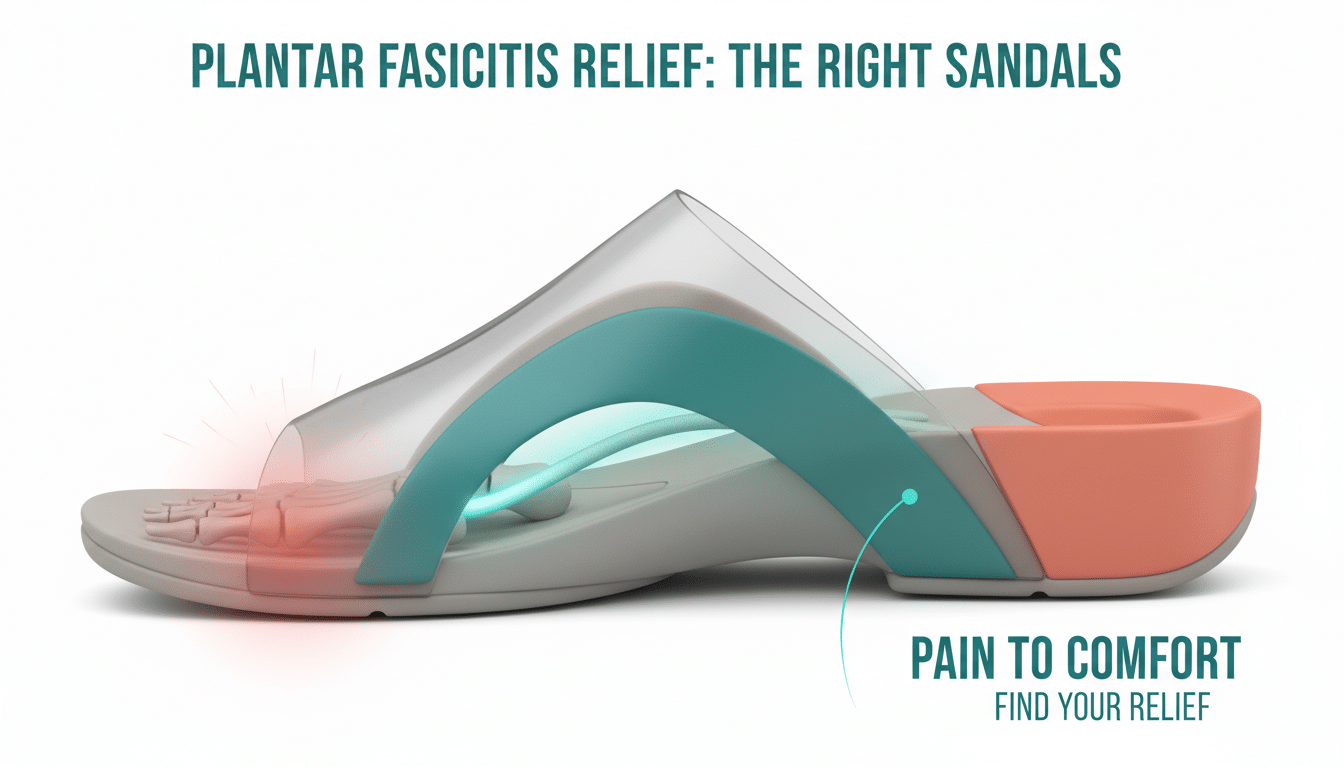

Sandals for Plantar Fasciitis: What Actually Works (So You Can Stop Hobbling Around)
If you’ve ever swung your legs out of bed and immediately regretted being alive because your heel feels like it stepped on a Lego… hi. Plantar fasciitis is rude like that.
And here’s the annoying part: most cute, flat, “barely there” sandals are basically the enemy during a flare. They let your arch collapse, your heel wobble, and your poor plantar fascia do overtime like it’s trying to pay off your mortgage.
But you don’t have to spend summer trapped in sneakers like some kind of sweaty footed Victorian orphan. You just need sandals that are actually supportive (not “supportive” the way a flimsy flip flop lies to you).
Let me show you what to look for, what to skip, and a few specific pairs that tend to work really well.
First: Why plantar fasciitis hates your favorite flat sandals
Your plantar fascia is that thick band of tissue that runs from your heel to your toes. When your arch collapses over and over (often because of overpronation your foot rolling inward), it pulls on that tissue until it gets cranky and inflamed.
Flat sandals usually give you:
- Zero arch structure (so your arch drops every step)
- No heel stability (so your foot sloshes around like a fish in a bag)
- Thin soles (so every sidewalk crack sends a personal hate letter to your heel)
A good sandal fixes those weak points. And once you wear a truly supportive pair for a day, putting on a flat flip flop feels… unhinged. Like choosing to sit on the floor when there’s a perfectly good chair right there.
The “don’t get fooled at the store” checklist: 4 features that actually matter
Ignore the buzzwords. If a sandal doesn’t have these four things, it’s probably not helping your plantar fasciitis.
1) Real arch support (not a random speed bump)
You want a contoured footbed where the arch rises in a way that makes anatomical sense starting at the heel and supporting through the midfoot.
My quick test: press your thumb into the arch area.
- If it feels firm, good.
- If it feels like a sofa cushion, it’ll pack down and you’ll be back to Pain City by Tuesday.
Also: arch support shouldn’t feel like it’s trying to stab you. Supportive? Yes. Pointy? No.
2) A deep heel cup (your heel needs a “seat,” not a suggestion)
A deeper heel cup helps keep your heel centered and stable, which reduces that side to side wobble that can feed overpronation.
Easy check: run your finger around the heel area. You should feel actual “walls,” not a gentle curve that does nothing.
3) A firm midsole (aka: do the twist test)
This is where a lot of “comfy” sandals betray you. Super squishy can feel amazing for five minutes… and then it collapses like a cheap lawn chair.
Do this in the store: grab heel and toe and twist.
- If it wrings like a wet towel, it’s too floppy.
- You want some flex, but it should resist twisting.
4) Cushioning that rebounds (not foam that gives up on life)
Good cushioning compresses when you step, then springs back. Bad cushioning just… stays squashed and sad.
Thumb test: press in. It should indent a bit and rebound quickly not leave a crater.
Bonus features I really like (but won’t yell at you about)
A small heel lift (roughly 0.5-2 inches) can take a little tension off the plantar fascia especially if your calves are tight. Over 2 inches, though, things can get weird fast (posture, pressure shifting, new pains popping up like whack a mole).
Adjustable straps are also a big deal. Feet swell during the day (rude again), and if your foot slides around, the “support” isn’t actually supporting the right spots.
My go-to supportive sandal picks (by real life scenario)
I’m not married to any brand, but these are the ones I’ve seen work again and again for people sorting out Birkenstock footbed options (and yes, I’ve worn some of them while shuffling around my kitchen like a dramatic grandma).
If your heel pain is fresh and spicy and you need relief now
- Vionic (great “first supportive sandal” for a lot of people, usually minimal break in)
- Aetrex Jillian (solid arch + a secure strap so your heel isn’t sliding around)
If you want something super adjustable for lots of walking
- Teva Terra Fi 5 (sporty, stable, doesn’t pack down quickly)
- Chaco Z/1 Classic (firm and supportive. The arch works for people who find aggressive arches too much)
If you want “house sandals” so your floors stop attacking you
This matters more than people think. If you wear supportive sandals outside, then go barefoot on hard floors inside… it’s like brushing your teeth and then eating Oreos in bed.
- OOFOS OOahh (plush and forgiving)
- Hoka Ora Recovery Slide (very cushy, great if your feet want to be babied)
If you want supportive but not wildly expensive
- Birkenstock Arizona Soft Footbed (classic for a reason supportive, stable, and yes, they take a minute to break in)
If you need arch support in a flip flop-ish situation
- Aetrex Lynco flip flop styles (not as stable as a strapped sandal, but miles better than a flat flip flop)
If you’re trying to salvage sandals you already own
- Tread Labs insoles (especially if you have sandals that can accommodate an insert some people do really well with their different arch height options)
How to tell if a sandal fits (and won’t ruin your day)
If you can, try them on later in the day. Feet swell. It’s normal. It’s also why shoes that feel “perfect” at 9 a.m. can feel like foot prisons if you skip your best width fit at 4 p.m.
My simple fit test:
- Walk for 10-15 minutes. Not two steps on carpet. Actually walk.
- Your heel should stay centered (not sliding side to side).
- The arch should feel supportive, not sharp.
- No hot spots. No rubbing. No “it’ll be fine once I break them in.” (That’s how blisters and regret are born.)
If you buy online: pick brands with a solid return window and do your “walk test” indoors for a couple of days before you commit. Outside scuffs are basically the kiss of death for returns.
Sandals I’d avoid during a flare (even if they’re cute)
- Traditional flat flip flops and flat slides (arch collapse city)
- Minimalist/zero drop sandals if your plantar fasciitis is active (they can load the fascia more)
- Heels over 2 inches (new problems tend to appear)
- Super cheap “supportive” sandals where the arch is just squishy foam (they flatten fast)
Breaking in supportive sandals without making everything worse
Supportive sandals can feel “different” at first like the footbed is bossy. That’s normal. What’s not normal is sharp pain.
Here’s the ramp up I like:
- Week 1: 2-3 hours a day (mostly indoors)
- Weeks 2-3: 4-6 hours, start wearing them out
- Week 4+: full day wear should feel comfortably supportive
Return them immediately if you get:
- Hot spots that feel blister-y
- Heel slip you can’t fix by adjusting straps
- Sharp arch pain
- Numbness/tingling
- Pain that spikes clearly above your usual baseline
Your feet should feel better supported by days 10-14 not increasingly furious.
Two tiny habits that help a lot (and don’t require a new personality)
1) Stretch before your feet hit the floor
That first step pain happens because everything tightens up overnight. Keep it simple:
- Calf stretch at the wall: 20-30 seconds, 3 reps per side, twice a day
- Plantar fascia/toe stretch: cross one leg over the other, gently pull toes toward your shin, 15-30 seconds, 3 reps per side, twice a day
Do at least one stretch before you start walking around in the morning. Your future self will write you a thank you note.
2) Stop going barefoot on hard floors
If you only change one thing, honestly, make it this.
Put supportive sandals next to your bed and slide them on before you take those first steps. Hardwood and tile are not “natural foot strengthening.” They are “tiny daily micro attacks.”
When you should stop Googling and go see a professional
Supportive footwear + stretching + smart activity changes often improves plantar fasciitis within 6-12 weeks. But please get checked out sooner if:
- Pain lasts beyond ~8 weeks despite consistent self-care
- Pain is on the outside of the foot (not typical heel/arch pattern)
- You have numbness/tingling or pain that travels
- Pain shows up at rest or wakes you at night
- There’s significant swelling, redness, or warmth
- You can’t bear weight comfortably
- Both feet hurt at the same time
And if you’ve genuinely done the right stuff for ~12 weeks with no improvement, it’s evaluation time. Custom orthotics can help some people (especially if multiple supportive sandals still don’t work), but it’s worth getting a pro’s eyes on the situation before you throw money at the problem.
Your simple plan (so you can wear sandals like a normal person again)
If you do nothing else, do this:
- Choose sandals with contoured arch support, a deep heel cup, a firm midsole, and cushioning that rebounds.
- Fit matters. If they rub or slip, return them. Don’t “power through.”
- Break them in gradually.
- Stretch calves + plantar fascia daily (especially before those first morning steps).
- Wear supportive footwear inside, not just outside.
Go check your current sandals right now. If the footbed is basically a flat pancake, congratulations you’ve found at least one reason your heel is still mad.