
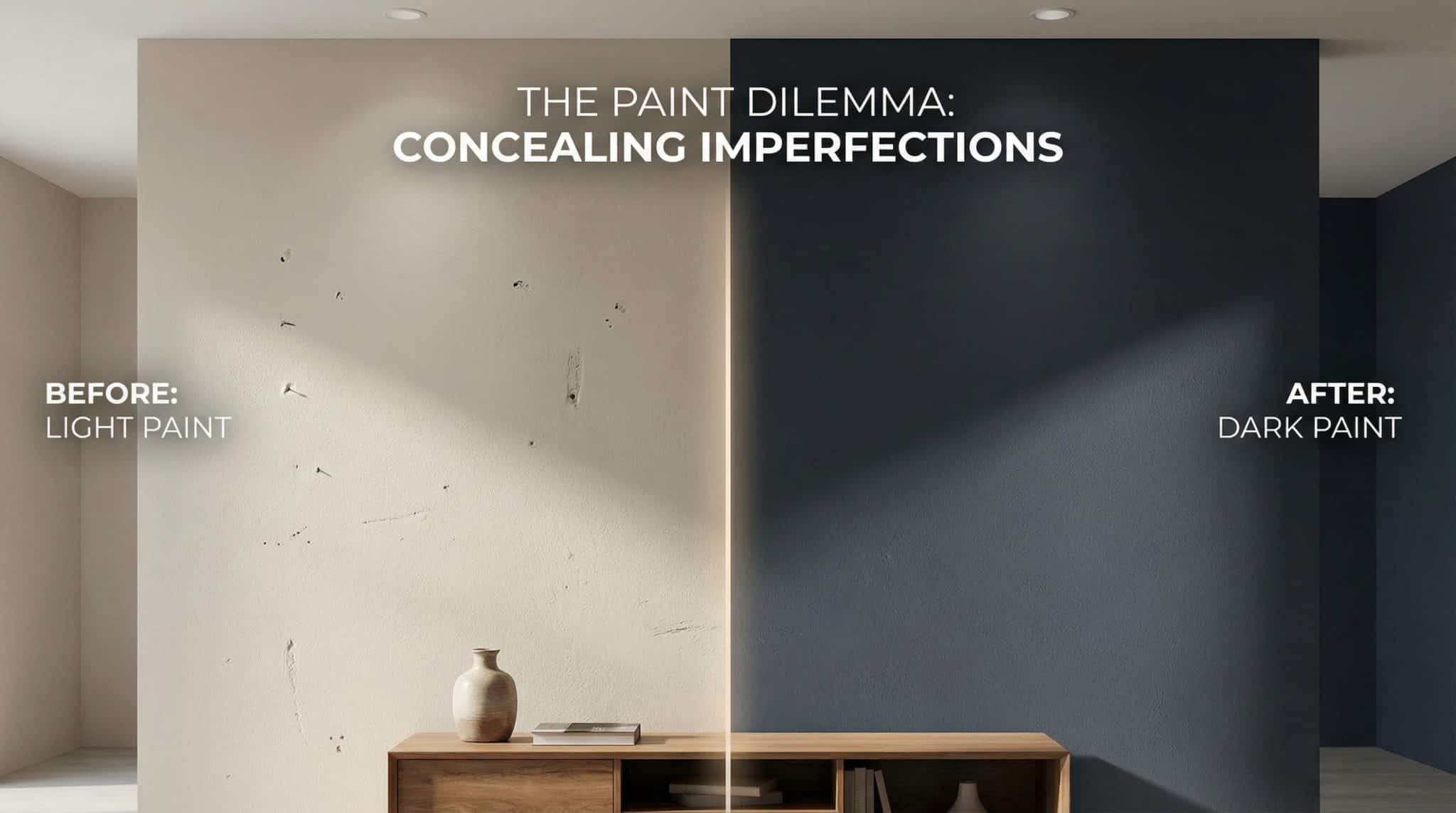

Does Dark Paint Hide Wall Flaws? (Sometimes. Don’t Yell At Me.)
You know that moment when you fall in love with a moody charcoal or deep navy… and then you remember your walls are basically a scrapbook of every picture hook you’ve ever hung? Yeah. Same.
Here’s the truth I wish more people would say out loud: dark paint can hide wall flaws… or it can spotlight them like they’re auditioning for a true crime documentary. It depends on three things:
- Your wall condition
- Your lighting
- Your paint finish (sheen)
Nail those, and you can absolutely have your dramatic, cozy, “expensive looking library” wall without seeing every dent you made moving the couch in 2019.
Let’s break it down in normal human language.
The 60 Second Reality Check (Before You Buy 3 Gallons of Regret)
1) How bad are your walls, honestly?
- Minor: a few nail holes, tiny dings, nothing screams at you from across the room.
- Moderate: lots of little dents, patch spots you can see in certain light, roller texture doing the most.
- Major: visible seams/tape lines, big patchwork zones, texture you hate, “why is the wall shaped like that?” vibes.
2) Is your lighting going to be a snitch?
This is the part people forget and then blame the paint.
Side lighting is the tattletale.
If you’ve got:
- a big window blasting light across the wall from the side,
- a floor lamp aimed at the wall like an interrogation spotlight,
- or any low angle light that creates shadows…
…your wall flaws are going to show up more. Even in dark paint. Especially in dark paint.
3) Are you about to pick the wrong sheen?
If you choose a shiny finish on imperfect walls, I can’t stop you, but I will quietly judge you while you cry into your paint tray.
More on that in a second.
So… Why Can Dark Paint Hide Flaws AND Also Expose Them?
Dark colors absorb light, which can make small bumps and unevenness less noticeable (yay!). But dents and patches also create shadows and shadows show up when the light hits your wall at the wrong angle (boo).
That’s why you’ll see a wall look flawless at 11 a.m. and then at 5 p.m. it’s like: Hello, yes, here is every time you missed the stud.
My Hot Take: Midtones Are the Unsung Heroes
Everyone thinks it’s either “bright white” or “near black drama cave.” But if your walls are anything less than perfect, midtone colors like a Sherwin Williams greige shade are usually the safest, prettiest sweet spot.
Think:
- warm pewter
- mushroom/taupe
- sage
- deep-ish navy (not pitch black navy)
- charcoal that’s more “cozy hoodie” than “black hole”
Why? Because super dark colors can create stronger contrast with shadows, which can make dents and patch edges easier to spot. Midtones tend to soften things without turning your wall into a flaw revealing stage.
If you’re nervous, start midtone. You can always go darker later (and yes, I know that’s annoying to hear, but it’s true).
Lighting: The Thing That Will Betray You at Sunset
If you want to know whether a wall is going to behave, do this:
At night, take a flashlight (or your phone light), hold it close to the wall, and aim it across the surface.
That “raking light” effect shows you exactly what side lighting will do. It’s like putting your wall under a lie detector.
Dark paint looks best when the light is:
- diffuse (soft overhead, not a spotlight)
- indirect (bouncing around the room)
- not blasting across the wall from the side
If the wall you want darkest is the wall that gets hammered by side sunlight every afternoon… you can still do it, but you’ll want to:
- go flatter with the finish,
- prep more,
- and maybe rethink any lamps that are aimed directly across it like you’re lighting a hostage video.
Finish Matters More Than Color (Yes, Really)
I know we all obsess over color names like “Witching Hour” and “Midnight Fjord” (paint marketers are poets), but choosing the right sheen is what decides whether your wall looks velvety or lumpy.
Here’s the cheat sheet:
- Flat / Matte: best at hiding flaws. Least reflective.
Downside: scuffs easier and can be fussier to clean. - Eggshell: the most practical “looks good + holds up” option for a lot of rooms.
Still forgiving, but not as delicate as flat. - Satin / Semi gloss: save it for trim, doors, cabinets.
On imperfect walls, it’ll highlight everything. Everything.
One more thing: dark paint can look shinier than you expect because of the tint/colorant load. So if you usually do eggshell, consider matte. If you’re thinking satin… gently back away.
The Dark Wall Maintenance Nobody Wants to Talk About
Dark walls can look amazing and hide that general dusty “blah” that happens over time… but they also love to showcase:
- fingerprints
- chair scuffs
- mystery streaks (how???)
- water spots
And touch ups can be annoying. Even the same color, same label, different can sometimes it flashes slightly.
If you go dark, do yourself a favor:
- keep a labeled quart from the original job
- store it somewhere not boiling hot or freezing
- write the batch number on it like you’re saving evidence for a future case
Also: if your walls take a beating (kids, dogs, office chair bumping into the wall daily), just know you might end up repainting the whole wall down the road instead of doing little spot fixes.
If You Want Dark Paint to Look Expensive, Prep Like You Mean It
I’m not here to ruin your weekend, but this is where the magic happens. Dark paint is less forgiving so the prep matters more.
Here’s my realistic prep routine:
- Clean the wall. Dust, grime, handprints get it off.
(In kitchens: yes, use a degreaser or TSP substitute. Grease is sneaky.) - Fill holes and dents with spackle/joint compound and let it actually dry.
Not “feels dry-ish.” Dry. - Sand smooth and wipe the dust off (a damp rag works, or a tack cloth).
- Prime. Especially if you patched a lot or you’re doing a big color change.
Pro tip: tinted primer can help with coverage when you’re going dark.
How far do you need to take it?
- A few dings: spot patch + sand is fine.
- Lots of dents all over: you’re in “sand more broadly + consider a high build primer” territory.
- Visible seams/patchwork everywhere: you may need skim coating… or you may want to consider a wall treatment (more on that below).
Application Tricks That Help (Because Technique Counts)
If your walls aren’t perfect perfect, you can help yourself by how you paint:
- Don’t overwork the paint. Keep a wet edge, don’t keep rolling the same spot until it’s dry and angry.
- Cross hatch your rolling (overlap in different directions) to avoid obvious roller lines.
- Accept a little texture. A tiny, even stipple from a roller can actually help disguise minor weirdness.
And if you’re staring at your walls thinking, “Skim coating sounds like my personal nightmare,” you’re not alone. Sometimes it’s smarter to skip the pain and do:
- textured wallpaper
- paneling/shiplap
- decorative wall panels
I’ve seen people patch sand repeat themselves into a full body existential crisis when a wall treatment would’ve been faster and honestly prettier.
Okay, So… Should You Paint Your Imperfect Walls Dark?
Here’s my friendly bottom line:
Go dark if:
- your flaws are minor,
- you’ll use matte/flat (or a forgiving eggshell),
- your lighting is soft (or you’re willing to adjust it),
- and you want that cozy, dramatic mood more than you want “wipeable perfection.”
Go midtone if:
- you want the safest, most forgiving option,
- your light changes a lot throughout the day,
- or you’re not trying to become a full time wall touch up artist.
Rethink paint as the only solution if:
- you’ve got major seams, heavy damage, peeling, water stains,
- or the prep is so intense you’d rather alphabetize your spice drawer for fun. (No judgment. We all cope differently.)
If you take nothing else from this: dark paint isn’t the enemy bad lighting and shiny sheen are. Test your color, pick a flatter finish than you think, and do the prep your wall deserves. Then go forth and make your room feel like a fancy little cave in the best way.