

Why Most Paint Colors Fail (And the Tiny Number That Saves You)
If you’ve ever painted a room and then stood there blinking at the wall like, “Excuse me… who is she?” you’re not alone. I swear paint colors have a secret hobby: looking amazing on a 2″ chip under fluorescent store lighting and then turning into a totally different creature the second you roll them onto your actual walls.
The thing that trips people up most isn’t that they “picked the wrong greige” (although… sometimes you did). It’s that you picked a color with the wrong LRV for your room.
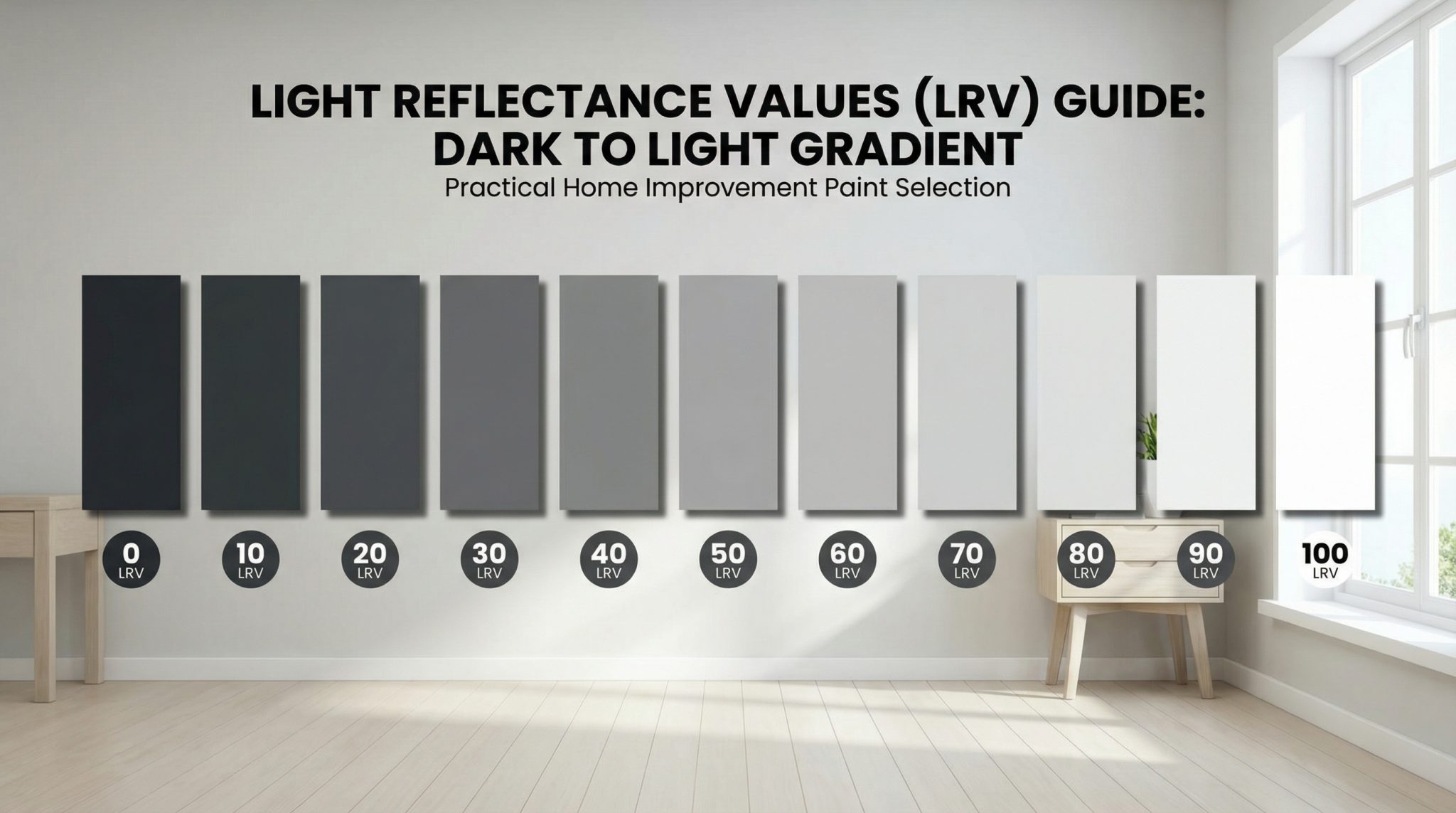
LRV = Light Reflectance Value. It’s a little number that tells you how much light a paint color bounces back into the room. And once you start using it, you’ll waste way fewer weekends rage painting.
Let me show you how to use it without turning this into a science fair project.
LRV in plain English (because we’re tired)
LRV is a 0-100 scale:
- 0 = theoretical black hole paint (not really sold at your local store)
- 100 = theoretical blinding white unicorn paint (also not really sold)
- Most real paints live somewhere around 5 to 85
And yes, it’s basically what it sounds like:
- LRV 65 means the color reflects about 65% of the light that hits it, and absorbs the other 35%.
The big takeaway I want tattooed on your brain (gently):
The “50 line” matters.
- Above 50 = generally reads brighter / airier
- Below 50 = generally reads moodier / deeper / “why does this hallway feel like a tunnel?”
And here’s the sneaky part that confuses everyone:
A high LRV does not mean “white.”
A butter yellow and a pale gray can have a similar LRV and look nothing alike. LRV only tells you brightness behavior, not undertones, not warmth/coolness, not whether it’ll clash with your floors. It’s the “how bright will this feel?” number. That’s it.
(Which is still wildly helpful, because brightness is usually where things go off the rails first.)
My quick and dirty LRV cheat sheet
These are rule of thumb ranges. Not commandments. Nobody needs paint math induced panic.
- 72-85: whites + off whites
Bright. Clean. Can get glary in strong sun. - 55-72: light colors
The sweet spot for most homes. Bright without feeling like a dentist’s office. - 40-55: medium tones
Gorgeous in bright rooms. Risky in dim rooms (unless you like “cozy cave”). - Below 40: dark colors
Dramatic and delicious… but you’ll need a lighting plan, not just vibes.
If you want a couple real world anchors (because I do too):
- Sherwin Williams Alabaster is around 82 LRV (a favorite for a reason)
- Sherwin Williams Accessible Beige is around 70 LRV (yep, it’s that bright)
- Benjamin Moore White Dove is around 85 LRV (very popular, very reflective)
You don’t have to memorize these. Just notice where they land.
Where you’ll find LRV (so you don’t have to squint in aisle 12)
Most paint chips will list LRV somewhere on the card (sometimes it’s hiding on the back like it’s shy). Online, brands usually list it in the color’s specs/details.
And if you can’t find it? Ask the paint counter. They can look it up. This is not you being high maintenance. This is you being a person who doesn’t want to repaint in six months.
The part nobody tells you: your windows rewrite everything
Same paint. Different room. Totally different result.
Here’s the quick version:
North facing rooms (cool, indirect light all day)
North light can make colors look duller and darker than you expected. If your room faces north and you don’t have massive windows, I personally start looking at LRV 60+ unless you’re intentionally going moody.
I once painted a north facing bedroom a “soft charcoal” that looked so chic on the chip. On the wall? It was giving “historical basement cell.” We fixed it with a lighter color and better lamps (because yes, I learned the hard way).
South facing rooms (warm, strong light)
These rooms can handle lower LRV without feeling heavy. If you’ve got strong southern light, you can usually explore LRV 40-55 and get that yummy depth without the room looking like it’s wearing a blackout curtain as a personality.
East/west rooms (the drama queens)
Morning sun vs. afternoon sun can make moody neutrals in different light feel like they have multiple identities. If you’ve ever loved a color at 9 a.m. and hated it at 4 p.m., welcome. You’re normal. Test your samples at different times.
The “double hit” to avoid
A low LRV paint in a low light room gets punished twice:
- the paint absorbs light
- there isn’t much light to begin with
That’s how you end up with “I wanted cozy” and got “is this a cave attraction?”
Don’t let your light bulbs sabotage you
Before you blame your paint, check your bulbs. Seriously.
Bulb temperature is measured in Kelvins:
- 2700-3000K = warm (yellow-ish)
- 3500-4000K = neutral-ish
- 5000K+ = cool/daylight (blue-ish)
This matters especially with whites and near whites (high LRV). A “crisp white” can look creamy or even weirdly yellow under warm bulbs. And a warm white can look icy under daylight LEDs.
Also: high LRV colors bounce back whatever is around them. Honey oak floors, a bright rug, a giant red sofa you refuse to part with paint will pick up those influences. (Paint is a people pleaser. It reflects the room’s energy. Unlike me. I do not reflect everyone’s energy.)
The LRV ranges I actually like by room (aka: paint without regrets)
Again: not law. Just a great starting point.
- Bedrooms: 45-65
I like bedrooms a touch softer. Too bright can feel sterile at night. - Living rooms: 60-72
The “works with life” range plants, art, kids, dogs, snack crumbs, etc. - Kitchens + bathrooms: 65-75
You want fresh and clean (and you want to actually see what you’re cleaning). - Home offices: 60-75
Your eyeballs will thank you when you look up from screens. - Hallways + basements: 65-82
Hallways love brightness. Basements need it unless you’re committed to full time speakeasy vibes.
“But what about trim?” (Yes, it matters)
When rooms connect, the goal is usually “flow,” not “why does this doorway feel like a jump cut?”
Two guidelines I use all the time:
- If multiple rooms are visible at once, keep the wall colors roughly within ~15 LRV points.
This avoids harsh brightness shifts as you move around. - Trim is usually 5-10 LRV points higher than the walls.
It’s a simple way to get definition without screaming contrast.
Accent walls are where you can break rules on purpose. Just make it a choice, not an accident you discover when the paint dries and you whisper, “Oh no.”
Quick exterior warning: dark paint + sun = potential mess
Exterior paint is a different beast.
Very dark colors like Sherwin Williams deep charcoal (low LRV) absorb heat, and that can mean more expansion/contraction, faster fading, and sometimes even surface issues depending on what you’re painting and where you live.
Some manufacturers have minimum LRV requirements for exterior colors (often somewhere around 35-45, depending on the product). If you go darker than they allow especially on a sunny wall you can void the warranty.
So if you’re dreaming of a moody charcoal exterior: check the product specs first. Don’t let your house become an expensive science experiment.
Also: sheen changes how bright a color feels
LRV is measured under standard conditions, but your walls are not living in a laboratory (unless your home decor style is “Mad Scientist Modern”).
In real life:
- Flat/matte often looks a bit darker because it absorbs/scatters light
- Eggshell is usually the most “what you see is what you get”
- Satin can read a touch brighter/cleaner
- Semi gloss/high gloss can look noticeably brighter (and shinier) great for trim, risky for full walls unless you want glow and glare
If you’ve got a dim room and a color feels muddy, sometimes bumping from matte to eggshell/satin helps more than you’d think.
My simple 4 step plan for picking paint without losing your mind
1) Read the room (literally)
North facing? Small windows? Lots of lamp light? Start looking 55+.
Big sunny room? You can explore down to about 40 without it feeling heavy.
2) Set your LRV “fence”
Pick a range, like 55-70, and ignore everything outside it. This is how you avoid staring at 40 similar swatches until your brain turns to oatmeal.
3) Sample within the range
Instead of sampling five random “pretty” colors, sample by brightness steps. For example, try something like:
- one around 55
- one around 62
- one around 70
You’ll figure out the right brightness level fast… and then choosing undertone becomes way easier.
4) Test like you mean it
Paint a sample at least 2 feet square (or use big peel and stick samples you can move). Then check it:
- morning
- midday
- night (with lamps on)
Give it a few days. Paint is moody, and it needs time to show you its whole personality.
If your paint looks “wrong,” here’s what’s probably happening
“It looks way darker than the chip.”
Yep. Store lighting is a liar. Next time, go 5-7 LRV points higher than your gut says or choose a slightly higher sheen for more bounce.
“My white looks pink/yellow/gray/weird.”
High LRV whites reflect everything. Your bulbs, your floors, your countertops, your giant tan sofa. Try a couple whites with different undertones and look at them for at least 48 hours in your actual lighting.
“I picked a high LRV and it still feels dark.”
Paint can only reflect the light that exists. If your lighting is sad and your furniture is blocking what little light you have, even LRV 82 can’t perform miracles. Add lamps, change bulbs, move the big stuff, then reassess.
The one thing LRV won’t do for you
LRV predicts brightness. That’s it.
It won’t tell you:
- undertone (warm/cool/green/pink)
- whether it’ll clash with your floors
- whether you’ll still love it after living with it for six months
Also: don’t get too precious comparing LRV across brands. They don’t all measure the same way, so a “65” from one brand isn’t guaranteed to match a “65” from another. Use LRV to narrow down within a brand, then trust real life samples on your walls.
The whole point (aka: save yourself the repaint)
If you use LRV first, you stop auditioning paint colors that were never going to work in your space. You’ll still test samples (because you’re not a magician), but you’ll be testing smarter.
So the next time you’re surrounded by paint chips and contemplating moving to a new house instead: check the LRV, pick a range that matches your light, and start there.
Your future self who would like to not repaint the same room twice will be very grateful.