
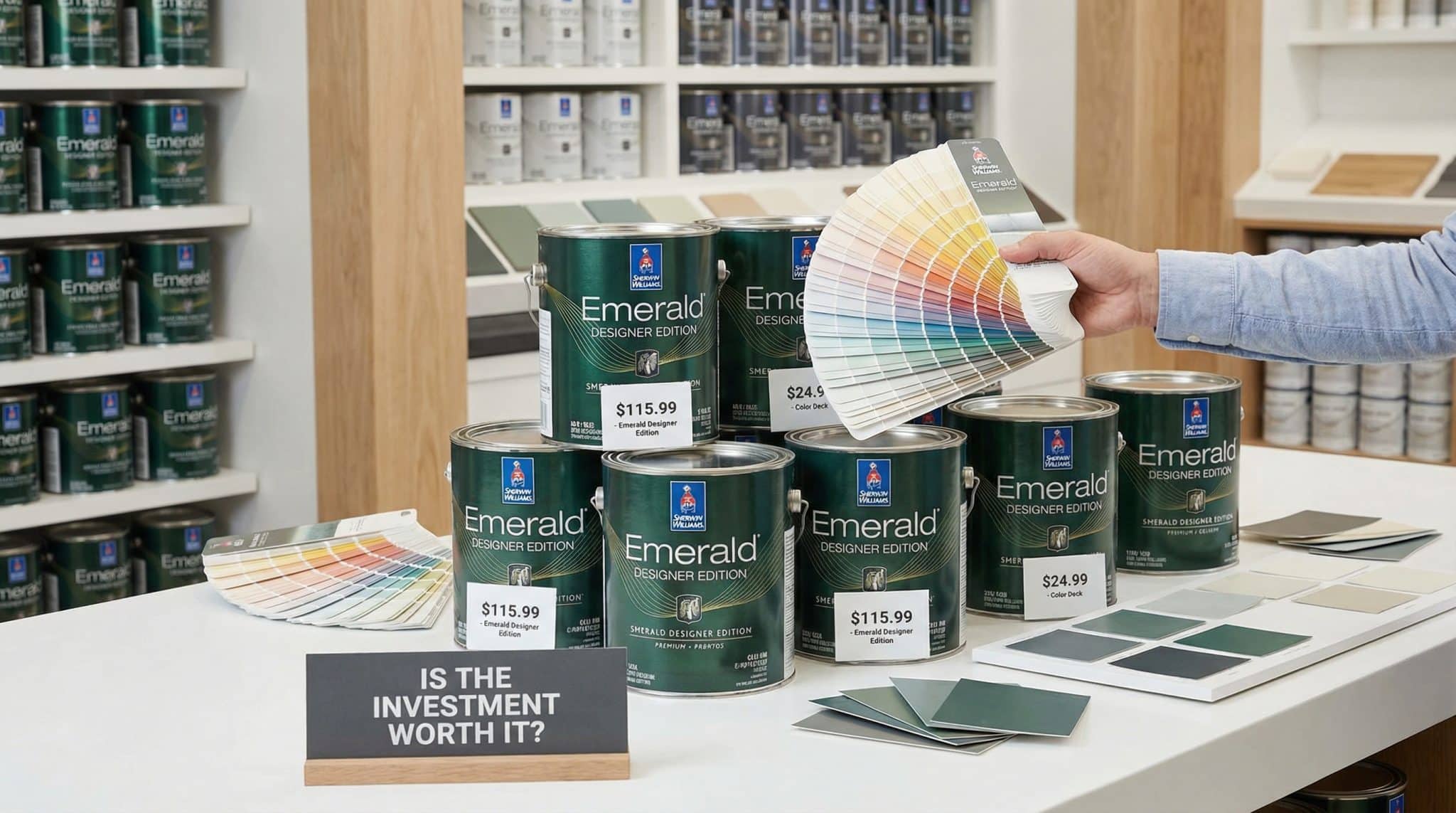
If you’ve wandered into a Sherwin-Williams store, fell in love with a color, and then saw the price tag on Emerald Designer Edition ($90+ per gallon) and briefly left your body… hi. Same.
This is absolutely “do I love this wall enough to fund its lifestyle?” paint. And sometimes the answer is yes! But sometimes the answer is: “Not for the laundry room, Brenda.”
Let’s talk about what makes Emerald Designer Edition different, when it’s genuinely worth it, and when you can keep your money for literally anything else (like the surprise plumbing issue that’s coming for you next month).
So… what are you actually paying for?
The big deal with Designer Edition is the base. It uses a brighter white base than other Sherwin-Williams interior lines, which means the colors can look cleaner, crisper, and a little more “designer showroom” on the wall—especially in whites and light neutrals, where undertones love to pop out and start a fight.
And yes, there are 200 colors that are exclusive to Designer Edition. Some of them are annoyingly hard (borderline impossible) to match in other lines because the formulas just aren’t the same.
So the first question isn’t “Is it good paint?” (it is). The first question is:
Is the color you want actually a Designer Edition exclusive?
Because paying extra for a non-exclusive color is basically paying for vibes. And I’m pro-vibes, but not $40-a-gallon-for-vibes.
Do this before you get emotionally attached: check the SW online color tool or flip through the in-store fan deck and confirm you’re actually looking at a Designer Edition only shade.
The sheen situation (a.k.a. the fine print that ruins the romance)
Designer Edition comes in: Flat, Eg-Shel (eggshell), Satin, and Gloss.
And here’s the part where I gently take your hand:
There is no semi gloss.
I know. Semi gloss is the reliable friend that shows up early with snacks. It’s what people want for trim, bathrooms, and anything that gets touched by sticky fingers. And Designer Edition said, “No thank you.”
My quick and dirty sheen opinions:
- Flat: Amazing at hiding wall flaws. Not my pick for areas where life happens aggressively (kids, dogs, you carrying laundry like a raccoon).
- Eg-Shel: The best “default” for most walls. Looks pretty, cleans better than flat, doesn’t punish you for existing.
- Satin: Great for kitchens/hallways if you want more wipeability—but it shows roller/brush drama more, so take your time.
- Gloss: Proceed with caution. It highlights every dent, patch, and moment of human imperfection. Also, cleaning can mess with the sheen if the paint isn’t fully cured. (Ask me how I know. Don’t actually. I’ll get upset.)
If you need semi gloss for trim or a steamy bathroom situation, you may end up using a different product—which brings me to the next important thing…
Where Designer Edition works… and where it absolutely does not
Designer Edition is for interior walls. That’s it. Not trim. Not exterior. Not “just the front door real quick.” Interior walls.
If you want a Sherwin-Williams product that behaves like a champ on trim/doors, you’re looking at something like Emerald Urethane Trim Enamel (different product, different mission in life).
Also: touch-ups. Listen to me, because this is where people get mad later.
Designer Edition colors aren’t the same as standard SW lines—even if the color name looks identical. So if you paint your living room in a Designer Edition color and later try to touch it up with regular Emerald… you’re going to get a little “patchwork quilt” moment you didn’t ask for.
My rule: if you buy Designer Edition, buy 1-2 extra quarts from the same batch before you leave the store. Put them somewhere safe. Label them. Guard them with your life. Future you will want to kiss present you on the forehead.
The colors: don’t scroll all 200 like it’s Netflix at 11 p.m.
Designer Edition is split into five palettes, which is helpful if you’re narrowing down warm neutrals like warm greige color review because staring at 200 paint chips will make you question your personality.
A quick vibe check:
- Pure and Pristine: clean whites with minimal undertones (for the “I want it bright but not sterile” crowd).
- Minimal and Modern: cooler grays and sleek neutrals.
- Warm and Welcoming: soft greiges and warm neutrals that play nicer in lower light.
- Classic and Collected: muted, timeless colors that don’t scream “trend.”
- Rustic and Refined: calmer greens/blues with that nature-y depth.
Also: lighting is the real interior designer in your house, whether you hired one or not when deciding between taupe shade vs Agreeable Gray. North-facing rooms can make a color go moodier. Warm bulbs can pull pink or creamy undertones out of “nice clean whites.” Your paint will not look like it did in the store. The store is basically a fitting-room mirror.
How I’d test these colors (without losing my mind)
If you’re spending Designer Edition money, you don’t “guess and pray.” You test.
I love peel and stick samples (like Samplize) because they’re fast and you can move them around. Stick them on a few walls, then look at them in the morning, midday, and at night. Give it at least 2-3 days.
And yes, order a few neighboring shades. Colors in this line can shift a little differently because of that brighter base, and what looks “basically the same” on a tiny chip can look VERY not the same on a full wall.
One extra note for my fellow white paint sufferers: warm LEDs (hello, 3000K) can drag weird pinky undertones out of some whites. Test in your actual lighting unless you want to enter your “why is my house blushing?” era.
Okay, but does it cover well enough to justify the price?
This is the part where Designer Edition can actually earn its keep.
On big projects or dramatic color changes (dark to light especially), better coverage can mean fewer coats. And fewer coats means less paint, less labor, less time spent with your arms falling off wondering why you started this.
I’ve seen people need an absolutely rude number of coats with some bright whites over deep colors. If Designer Edition cuts that down even by one coat across a whole house? That’s not nothing. That’s your weekend back.
Also, durability is excellent: scuff resistance, washability, that annoying shiny burnish you get on lower quality paints—Designer Edition is strong here. It’s a good pick for hallways, family rooms, anywhere your walls get casually assaulted by daily life.
But let’s not get delusional: primer still matters. If you’re covering stains, going dark to light, painting over glossy finishes, or dealing with tannins (certain woods), use primer. Primer is the broccoli of painting: unsexy, but it makes everything better.
How to buy it without lighting your wallet on fire
A few real-life shopping notes:
- It’s only at Sherwin-Williams stores. Not Lowe’s, not Amazon, not “some guy on Facebook Marketplace with a truck.”
- Watch for sales. Sherwin-Williams runs 30% off promos pretty often. At full price, Designer Edition feels like a splurge. On sale, it starts making a lot more sense.
- Ask about sizes. Some Designer Edition colors can be ordered in other SW products/sizes (like Duration Home in quarts or 5 gallon buckets) depending on the color. This can change the math fast if you’re painting a lot of square footage.
Personally? I try not to pay full price unless I’m on a deadline or I’ve already painted half the room and I’m not about to live with a two tone “I ran out of paint” situation.
So… when is Emerald Designer Edition actually worth it?
I’d splurge if:
- You’re in love with a truly exclusive Designer Edition color
- You’re doing a dramatic color change (especially dark to light) and want fewer coats
- You’re painting high traffic walls and you want that extra durability
- You can grab it during a 30% off sale (bless)
I’d skip it if:
- You’re painting a small/low traffic room where durability won’t matter
- You need semi gloss for trim or a bathroom and don’t want to juggle products
- You know you’ll need frequent touch-ups (kids, pets, chaotic neutral lifestyle)
- Your color exists in standard Emerald/Duration and looks basically the same in your lighting
The bottom line
Emerald Designer Edition is gorgeous paint with legit performance… but it’s not magic fairy dust for every project. It’s worth the money when you’re chasing a specific exclusive color, tackling a big color change, or painting walls that need to hold up to real life without looking scuffed and sad in six months.
If you’re just painting a guest room beige (no judgment, beige pays the bills), standard Emerald or Duration will treat you just fine—and you can use the savings on something truly important. Like new throw pillows you absolutely do not need but will buy anyway.