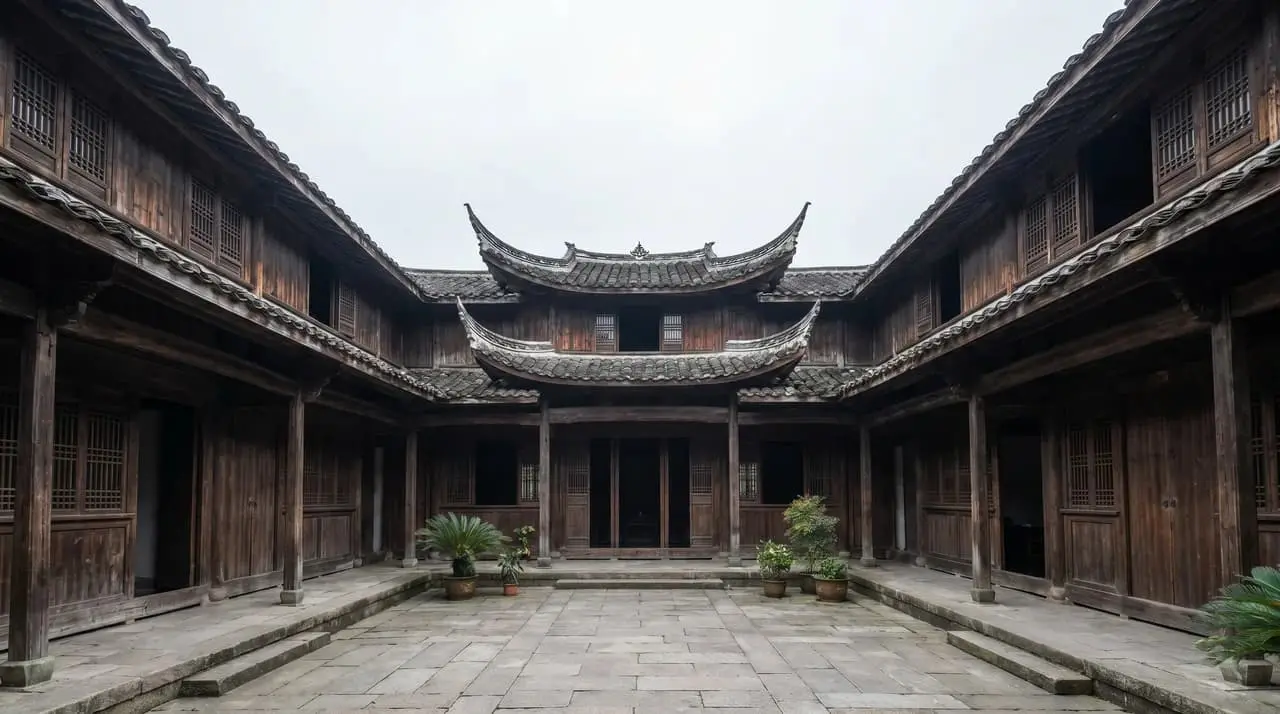
Chinese architecture is one of the world’s most consistent and recognizable building traditions. Its principles have shaped structures across centuries, climates, and social scales.
Every element in a traditional Chinese building carries meaning. Layouts reflect hierarchy, materials express philosophy, and even colors and numbers signal status.
Here you’ll find everything from the engineering behind timber frames to the symbolism embedded in rooflines, courtyards, and spatial planning.
What makes this tradition worth understanding is how little its core logic has changed, and how clearly it still shows up in buildings being designed today.
What is Chinese Architecture?
Chinese architecture is built on one core belief: that a structure should reflect the order of the cosmos.
The relationship between heaven, earth, and human life shaped every decision. Which direction a building faced, how its spaces were arranged, and which materials were used.
The Four Core Characteristics
Four characteristics appear consistently across every era: bilateral symmetry, enclosed open spaces, a strong horizontal emphasis, and careful directional orientation rooted in feng shui.
These aren’t decorative choices. They’re expressions of the same underlying philosophy, applied consistently for over two thousand years.
What makes this a tradition rather than a style is continuity. The same organizing principles that shaped the Forbidden City also governed rural farmhouses and village temples. The scale changed, but the logic didn’t.
The Philosophy Behind the Forms
Three philosophical traditions shaped how Chinese buildings were conceived.
- Daoism emphasized working with natural forces.
- Buddhism shaped the formal vocabulary of religious structures.
- Confucianism provided the social logic.
The strict hierarchy encoded in a building’s axis, the placement of the most important structure at the center, the symmetrical flanking of secondary buildings: these all reflect Confucian ideas about social order made visible through space. The architecture didn’t just house hierarchy. It expressed it.
Reach and Exceptions
The timber frame system, courtyard logic, and roof forms were adopted across East Asia.
Japan, Korea, Vietnam, and Mongolia all built within a framework that originated in China, with each culture absorbing the core principles and inflecting them through local materials and traditions.
The Hakka tulou of Fujian is worth noting as an exception. These circular earthen fortresses look nothing like palaces or temples, yet the philosophy remains intact.
Climate, terrain, and the demands of communal living pushed the forms into something entirely different, but the same thinking about space, orientation, and community remains beneath the surface.
How Did Chinese Architecture Develop Over Time?
The core logic of Chinese architecture has been remarkably consistent, but it didn’t arrive fully formed. It evolved through distinct dynastic stages, each one building on what came before.
The Tang Dynasty (618–907 CE) is widely considered the high point of classical Chinese architecture. Structures from this period are bold and expansive: wide bracket sets, sweeping eaves, and a confident use of scale. The Nanchan Temple’s Great Buddha Hall, the oldest surviving wooden structure in China, dates to this era.
The Song Dynasty (960–1279 CE) moved toward greater precision and refinement. Structures became lighter and more technically intricate.
It was during the Song that the Yingzao Fashi, a comprehensive government architectural manual codifying building standards and bracket classifications, was compiled by Li Jie in 1103. It remains the oldest complete technical treatise on Chinese architecture still in existence.
The Ming (1368–1644 CE) and Qing (1644–1911 CE) dynasties represent the period of consolidation. The Forbidden City, built under the Ming, demonstrates the fully developed classical system at its largest scale. Glazed tile production was perfected, and garden architecture reached its most elaborate expression.
What changed across these periods was refinement and scale. What didn’t change was the underlying system: timber frames, courtyards, axes, and the same cosmological logic applied from the smallest farmhouse to the imperial palace.
Why Did Chinese Builders Choose Wood?
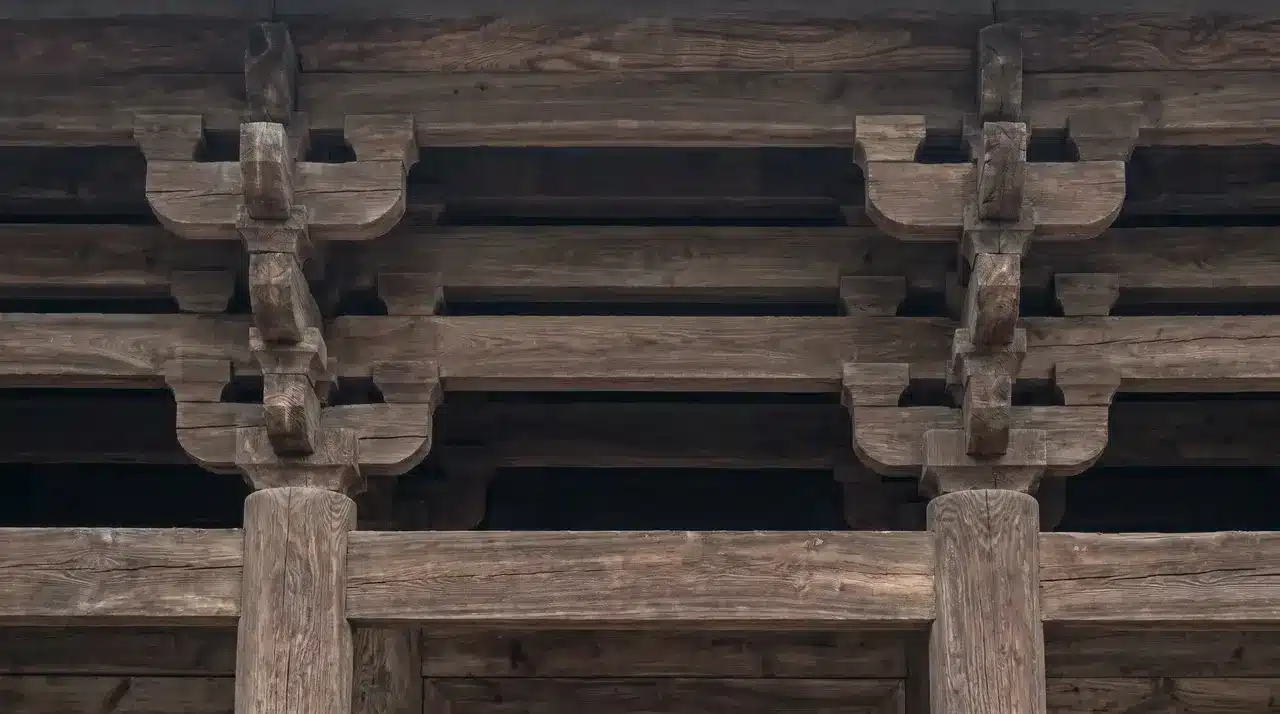
Wood wasn’t a fallback.In a region prone to earthquakes, it was the right material, and Chinese builders understood exactly why.
Stone resists force. Wood absorbs it. When the ground moves, a timber frame flexes and recovers. A masonry wall cracks and collapses.
That difference explains why wooden structures built over a thousand years ago are still standing today.
There’s also a philosophical dimension that mattered deeply to the people building these structures. Daoism values working with natural forces rather than against them.
A material that yields under pressure and returns to form fits that worldview precisely. The choice of wood wasn’t just practical. It was an expression of how Chinese builders thought the world worked.
How Does the Bracket Set (Dougong) Actually Work?
The bracket set, called dougong in Chinese, is the structural element most associated with traditional Chinese architecture. Most people have seen it. Few can explain what it actually does.
How It’s Built
It sits between the top of a column and the underside of the roof. Instead of transferring the roof’s weight straight down through a rigid joint, the dougong steps outward in a stack of interlocking wooden arms.
Each arm distributes load across a wider surface than the one below it. No nails hold any of it together. The pieces interlock through a precise mortise-and-tenon connection: a projecting tenon cut into one piece fits into a corresponding mortise cut into the next.
The friction fit is tight enough to bear load under normal conditions, but loose enough to allow micro-movement under seismic stress. No adhesive, no fastener. Just geometry doing structural work.
Why It Matters
That means the joint can move during an earthquake and return to its position without breaking. The roof shifts. The columns shift. Neither tears the other apart. It’s a system designed for resilience, not rigidity.
The dougong also solves a second problem: how to extend a heavy, wide roof far beyond the wall without it collapsing. By gradually stepping the load outward, the bracket allows the roof to cantilever dramatically.
Those overhanging eaves that define the Chinese roofline aren’t decorative. They’re a direct result of the structure beneath them.
How Space and Symmetry Organize a Chinese Building?
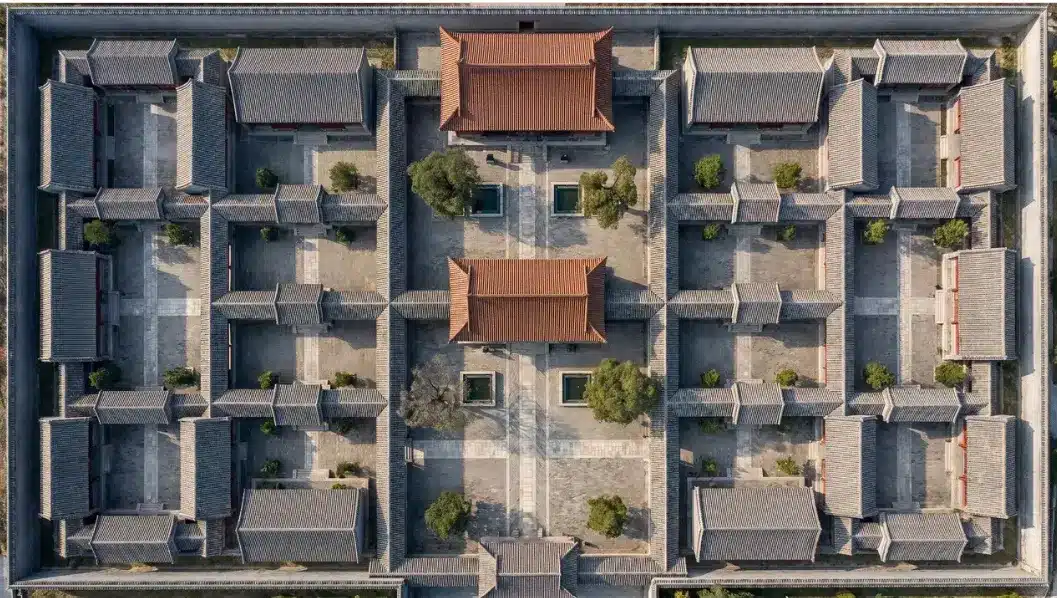
The layout of a traditional Chinese building isn’t a practical afterthought. It’s a deliberate system that connects architecture, social hierarchy, and daily life, all in the same set of decisions.
These are the five spatial principles that appear across everything from imperial palace complexes to village courtyard homes.
- Central axis and hierarchy. Traditional complexes align along a south-to-north axis. The most important structures sit at center; secondary buildings flank them symmetrically. This isn’t aesthetic preference. It’s the social order made physical.
- South-facing orientation. Most buildings face south to capture winter sun and block cold northern winds. The functional and cosmological reasoning point in the same direction: what’s climatically correct is also philosophically correct.
- Courtyards as the organizing center. Courtyards aren’t leftover space. They introduce light and air into the compound and serve as the social core of daily life. Everything else is arranged around them.
- Inward-facing rooms. Rooms open onto internal courtyards rather than the street. Privacy is structural, not incidental.
- Interior over facade. Traditional Chinese architecture rewards the person moving through it, not the person looking at it from outside. The sequence of spaces is the design.
The Forbidden City shows this logic at its most developed. Multiple courtyards line a single central axis, each one increasing in importance as you move deeper toward the emperor’s residence. The spatial sequence is the message.
Vernacular buildings, courtyard homes, and village compounds follow the same rules at a smaller scale. What changes is the size. What stays constant is the underlying thinking.
Does Chinese Architecture Look the Same Everywhere?
No. The organizing principles are consistent, but the forms they produce across China’s regions are strikingly different. Climate, available materials, terrain, and local cultural traditions all pushed the same underlying logic into distinct expressions.
Six regional styles are widely recognized, and each one answers the same questions differently.
| Regional Style | Key Characteristics |
|---|---|
| Beijing (Jing) | Formal courtyard compounds, strict axiality, grey brick walls, grey roof tiles. The defining style of northern imperial architecture. |
| Suzhou (Su) | Intricate garden design, whitewashed walls, dark roof tiles, layered spatial sequences. Best known through the classical gardens of Suzhou. |
| Anhui (Hui) | White-plastered walls, black tile roofs, horse-head gabled walls used as firebreaks, elaborately carved wooden interiors. |
| Sichuan (Chuan) | Buildings elevated on stilts, bamboo and timber construction, designed for ventilation and moisture management in a humid mountain environment. |
| Fujian (Min) | Hakka tulou circular earthen fortresses and coastal multi-family compounds, shaped by communal defense needs and southern coastal conditions. |
| Shanxi (Jin) | Wealthy merchant courtyard compounds featuring multiple enclosed courtyards and elaborate carved decorations. |
The same principles appear across all of them: symmetry, orientation, inward-facing rooms, courtyard organization. What changes is what those principles look like when filtered through a different place.
What Roofs, Colors, and Numbers Actually Signal?
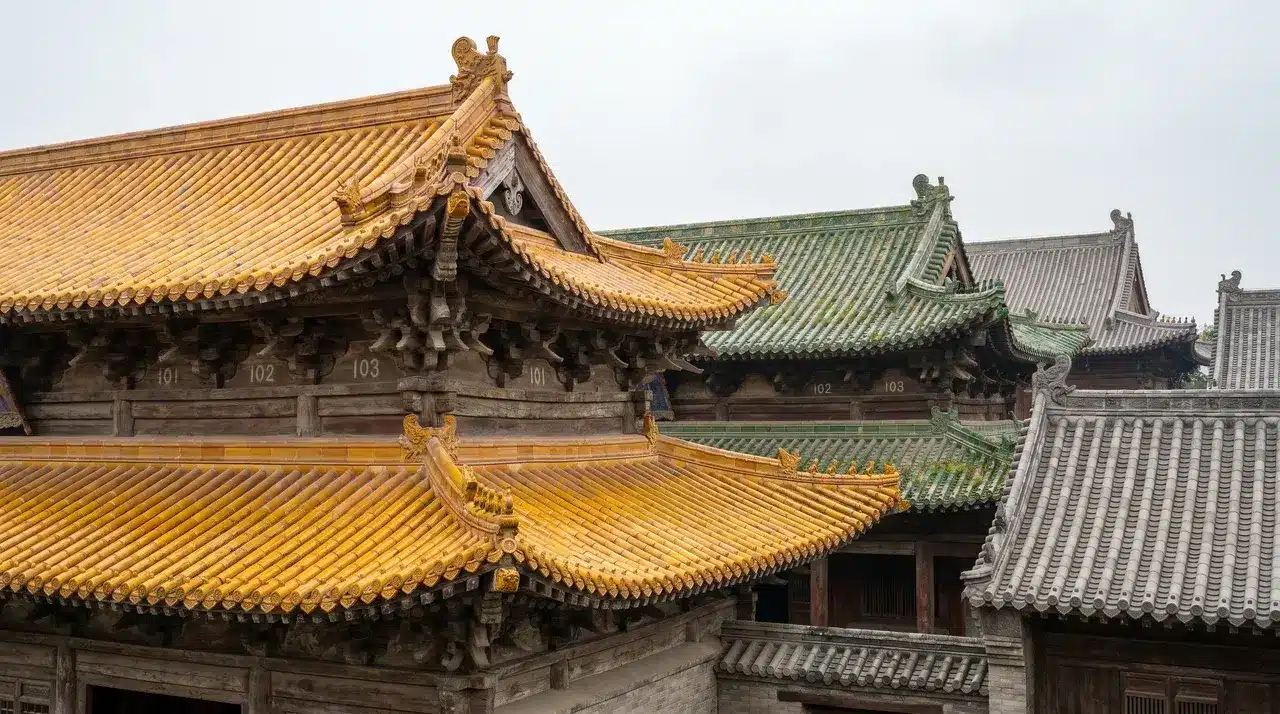
Traditional Chinese buildings communicate information visually. Roof forms, tile colors, and numerical patterns were each part of a legible system, one that told you a building’s status, purpose, and place in the social order before you ever walked through the door.
1. Roof Design Carried Practical and Symbolic Meaning
The upturned eaves that define traditional Chinese rooflines weren’t purely aesthetic. They solved real problems while carrying symbolic weight at the same time.
Three things the curved eave accomplished simultaneously:
- Water management. The outward curve directs rainwater away from walls and foundations, protecting the timber structure beneath.
- Weather protection. Extended eaves shield walls, windows, and entrances from direct exposure to rain and sun.
- Symbolic connection. The upward sweep was understood as expressing the relationship between the earthly and the heavenly. The building reaching upward rather than sitting inert on the ground.
Form and function weren’t in tension here. They pointed in the same direction.
2. Colors Indicated Rank and Function
Color wasn’t just a design choice. It was regulated. In many periods, using the wrong color on a building was a social and legal violation, not just an aesthetic misstep.
| Color | Traditional Association |
|---|---|
| Yellow | Imperial buildings and the emperor |
| Green | Religious buildings and noble residences |
| Grey or Black | Homes of common citizens |
The roofline of a building told you who lived or worshipped inside before you reached the gate. That’s how intentional this system was.
3. Numbers Communicated Social Status
Numbers carried symbolic weight throughout traditional Chinese architecture. Specific figures appeared in door studs, stair counts, and spatial proportions, each one a deliberate signal about the building’s status.
Here’s how the key numbers mapped to hierarchy:
- Nine was associated with imperial authority. It was considered the highest single digit and appeared most prominently on structures at the top of the social order.
- Sevens and fives appeared on lower-status buildings, used in proportions and decorative counts that reflected a building’s rank.
- Eighty-one (9×9) appeared in the most important imperial structures, including the gate studs within the Forbidden City, as the fullest expression of imperial numerical symbolism.
These weren’t superstitions applied loosely. They were a consistent, governed system used to signal status through the architecture itself.
4. The Square-and-Circle Concept
One of the most important symbolic relationships in Chinese architecture comes from a single belief: Heaven is round. Earth is square.
This wasn’t surface decoration. It influenced entire building layouts. The Temple of Heaven in Beijing is the most direct example: a circular prayer hall set within a square enclosure.
The cosmological idea is expressed through the geometry of the plan itself, not painted on the wall.
5. Reading the Architectural Language
Once you understand these signals, a traditional Chinese building becomes readable. Each element belongs to a larger system of visual communication.
- The roof form suggested the building’s purpose: temple, palace, or home.
- Color indicated rank within the social hierarchy.
- Numbers confirmed status through deliberate detail counts and proportions.
- Geometry expressed the building’s relationship to cosmological belief.
A visitor who understood this system could read a building’s entire context: who it served, what it meant, where it stood in the order of things. Just by looking at it.
How Do Contemporary Chinese Architects Use Ancient Principles?
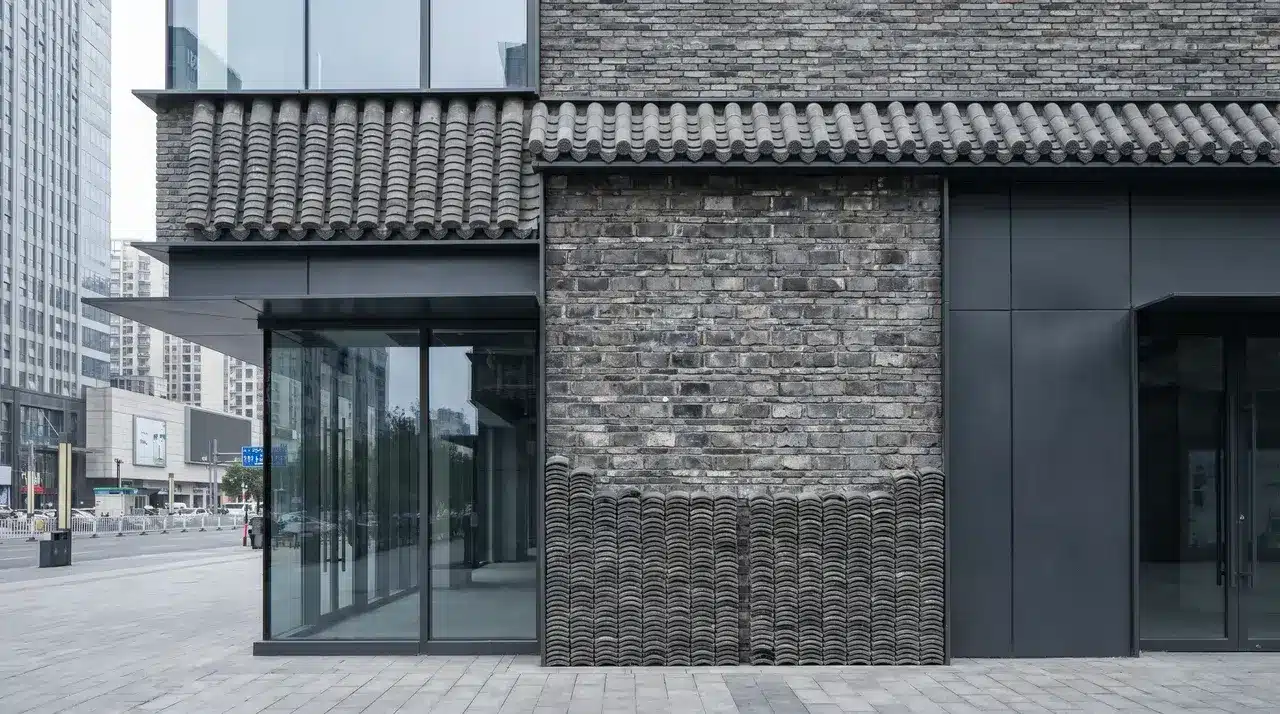
Modern Chinese architects aren’t recreating traditional buildings. What many are doing is more interesting: applying the same underlying ideas to contemporary materials, communities, and urban challenges. The forms look different. The thinking behind them often doesn’t.
Wang Shu: Building with Place in Mind
Wang Shu’s work is closely associated with reclaimed materials, tiles, and bricks recovered from demolished villages. What makes this more than aesthetic is how he uses them.
In projects like the Ningbo History Museum (2008), millions of tiles salvaged from demolished villages are set directly into the concrete walls. Not as cladding, but as part of the structure’s surface. The result is a building that carries the texture of what was there before it.
The principle is a direct echo of a long-standing idea in Chinese architecture: buildings should respond to their specific environment rather than exist apart from it.
Wang Shu won the Pritzker Prize in 2012, architecture’s highest recognition. The jury specifically cited the way his work draws on Chinese tradition without replicating it. That distinction matters.
Liu Jiakun: Designing Around Community
Where Wang Shu works through material memory, Liu Jiakun works through social function. His architecture is less concerned with how a building looks than with what it enables the people inside it to do.
His buildings typically use local materials and create spaces that encourage interaction. Not just movement between rooms, but genuine social exchange.
The emphasis on enclosure, shared space, and communal activity echoes the courtyard logic that has defined Chinese architecture for centuries. The concept of a courtyard doesn’t require a courtyard. The idea is portable.
Adaptive Reuse and Urban Regeneration
One of the most visible trends in contemporary Chinese architecture is the shift from demolition to transformation. Older industrial sites and historical structures are being converted rather than cleared, and the results often serve communities better than new buildings would.
Common outcomes of this approach include:
- Community centers embedded in repurposed factory buildings
- Cultural venues that preserve the memory of a site’s industrial past
- Art galleries inserted into warehouses or storage facilities
- Public gathering spaces carved from formerly private or commercial structures
The parallel to traditional courtyard architecture is direct. Both approaches treat architecture as a container for social life, a place where daily activity, community, and culture can take root.
A Different Direction from the Megaproject Era
Not all contemporary Chinese architecture moves in the same direction. Two very different approaches are happening at the same time.
| Approach | Primary Focus |
|---|---|
| Community-focused architecture | Local materials, social function, neighborhood identity |
| Megaproject architecture | Engineering scale, iconic forms, global design language |
Projects like Beijing Daxing International Airport and CITIC Tower are engineering achievements at a scale that demands attention.
But a growing number of Chinese architects are making a deliberate choice to work smaller, slower, and closer to the communities they’re designing for. Both strands are real. They just answer different questions about what architecture is for.
Chinese Architectural Buildings that Still Exist Today
These four structures span over a thousand years of Chinese building history. Each one survived not just time, but earthquakes, invasions, and dramatic political change.
They remain the clearest places to see traditional Chinese architectural principles in their original, physical form.
1. Nanchan Temple (Xinzhou, Shanxi)
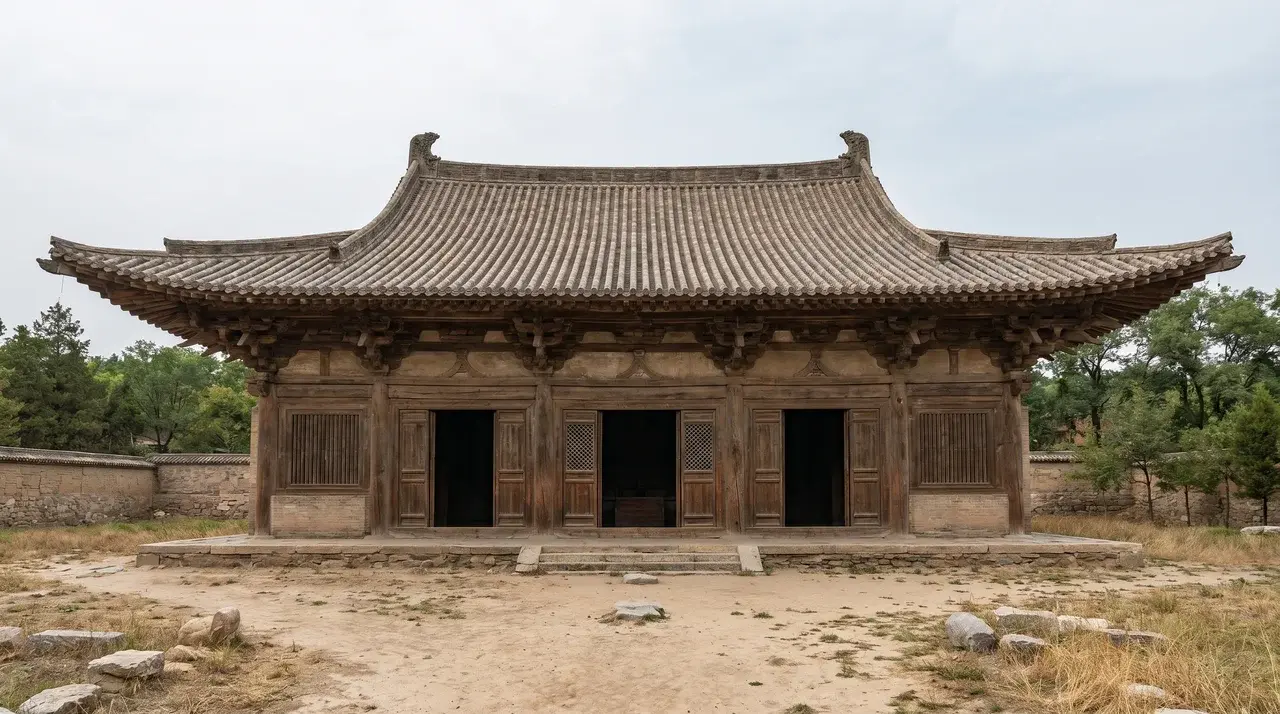
Built in 782 CE during the Tang Dynasty, the Great Buddha Hall at Nanchan Temple is the oldest surviving wooden structure in China, predating almost all other buildings from the same period.
Its timber frame, bracket sets, and proportions offer some of the clearest surviving examples of early Tang construction techniques.
Most wooden buildings from this period were destroyed during the Buddhist persecution of 845 CE. Nanchan Temple survived due to its remote, mountainous location in Shanxi province, which placed it far from the centers of destruction.
That geographic isolation preserved something rare: direct physical evidence of how Chinese builders worked over 1,200 years ago, before the Tang system was refined, codified, or lost.
2. The Hanging Temple (Datong, Shanxi)
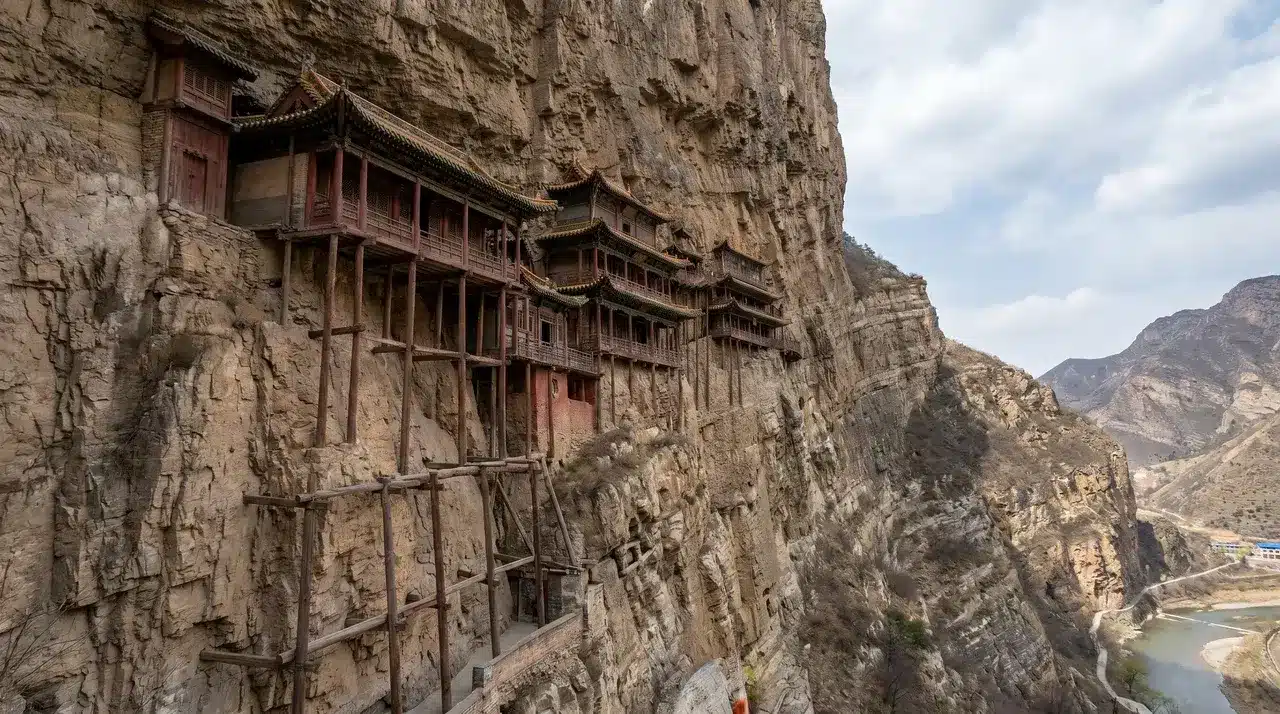
The Hanging Temple near Mount Heng appears to defy gravity. Built into a sheer cliff face, the structure is supported by wooden crossbeams driven directly into the rock.
It has stood for over 1,400 years. The engineering is striking, but the site selection is equally deliberate, taking advantage of natural protection from rain and sunlight.
The cliff overhang above the temple shields it from decay. Builders weren’t just solving a structural problem. They were reading the landscape and letting it do part of the work.
That instinct, using the site as a partner rather than an obstacle, shows up across the tradition at every scale.
3. Potala Palace (Lhasa, Tibet)

Potala Palace sits at 3,700 meters above sea level on Marpo Ri hill in Lhasa. Construction of the current structure began in the 17th century, continuing a site occupied since the 7th century.
The building reflects Tibetan architectural tradition rather than Han Chinese conventions, but the underlying logic aligns with both. The White Palace served as administrative and residential quarters. The Red Palace housed religious spaces and the tombs of past Dalai Lamas.
The vocabulary is Tibetan, but the organizational logic is legible to anyone who has read a Han Chinese building: function divided by space, rank expressed through placement, color carrying meaning. Different tradition, same underlying grammar.
4. Giant Wild Goose Pagoda (Xi’an, Shaanxi)
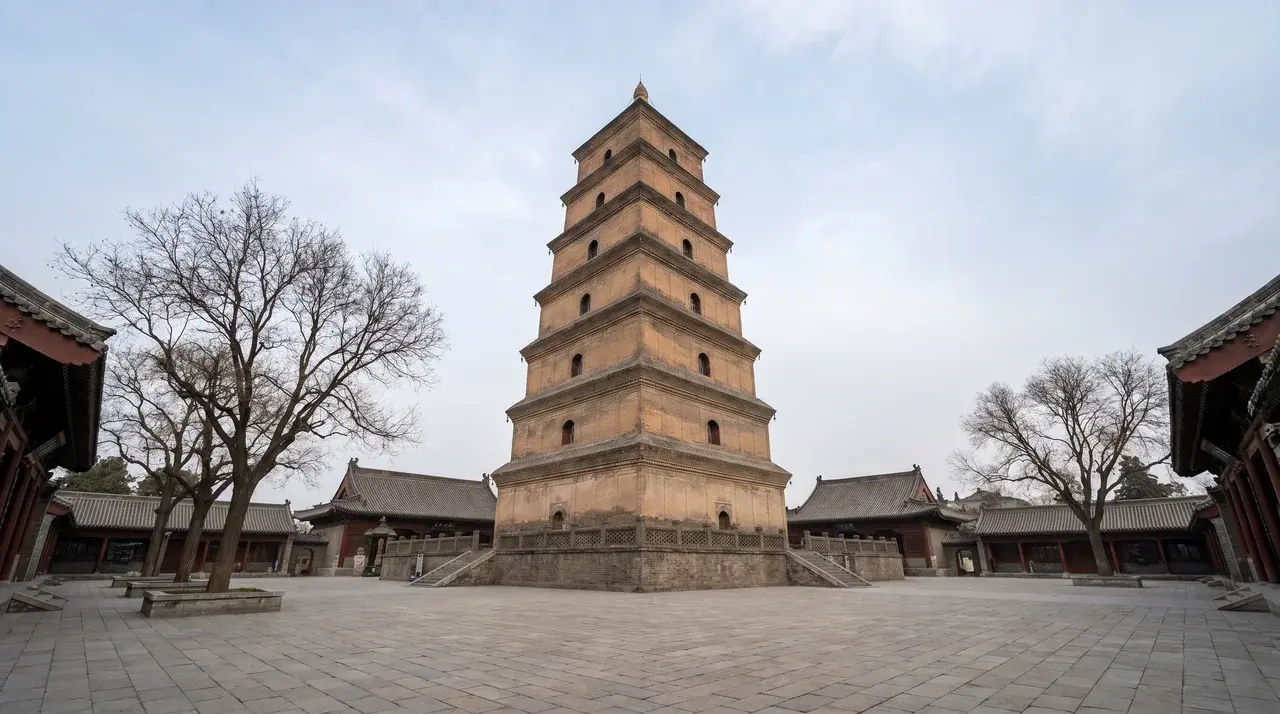
Originally built in 652 CE during the Tang Dynasty, the Giant Wild Goose Pagoda in Xi’an was constructed to house Buddhist sutras brought by the monk Xuanzang.
It has been rebuilt and modified multiple times. The current seven-story structure dates primarily from a major renovation in 704 CE, preserving its historical Tang Dynasty architecture.
The pagoda form is a Chinese adaptation of the Indian stupa, transformed over centuries into something distinctly local. Its square base, tapering profile, and vertical emphasis contrast with the horizontal emphasis of traditional buildings.
That contrast is the point. The pagoda was designed to stand apart visually, to mark a sacred site from a distance. It does.
Wrapping Up
Chinese architecture rewards the kind of attention most people don’t give it. Look past the rooflines, and the real system underneath becomes visible.
The timber frame, the courtyard, the orientation, the color of the tiles: none of it is accidental. Every choice connects back to the same thinking.
Traditional buildings become readable in a way they weren’t before. You can see rank, purpose, and belief expressed through structure once you know what to look for.
Pick one building, the Forbidden City is the obvious starting point, and apply what you’ve learned here. The roof form, the orientation, the color of the tiles, and the depth of the courtyards. See how much more you notice.
Frequently Asked Questions
What are the main characteristics of Chinese architecture?
Traditional Chinese architecture is defined by bilateral symmetry, courtyard layouts, timber frames, a horizontal emphasis, and feng shui orientation, all of which express balance, hierarchy, and harmony with the natural world.
Why was wood used in traditional Chinese architecture?
Wood was preferred for its flexibility during earthquakes. Unlike rigid masonry, timber frames absorb movement without collapsing and are aligned naturally with Daoist values of working with natural forces.
How does feng shui influence Chinese architecture?
Feng shui shapes how buildings are sited, oriented, and organized. Most traditional structures face south for sunlight and wind protection, applying principles consistently from village homes to imperial cities.
What is the most famous example of Chinese architecture?
The Forbidden City in Beijing is the most recognized example, showcasing symmetry, courtyard progression, a central axis, and hierarchical spatial design at an unmatched scale.