
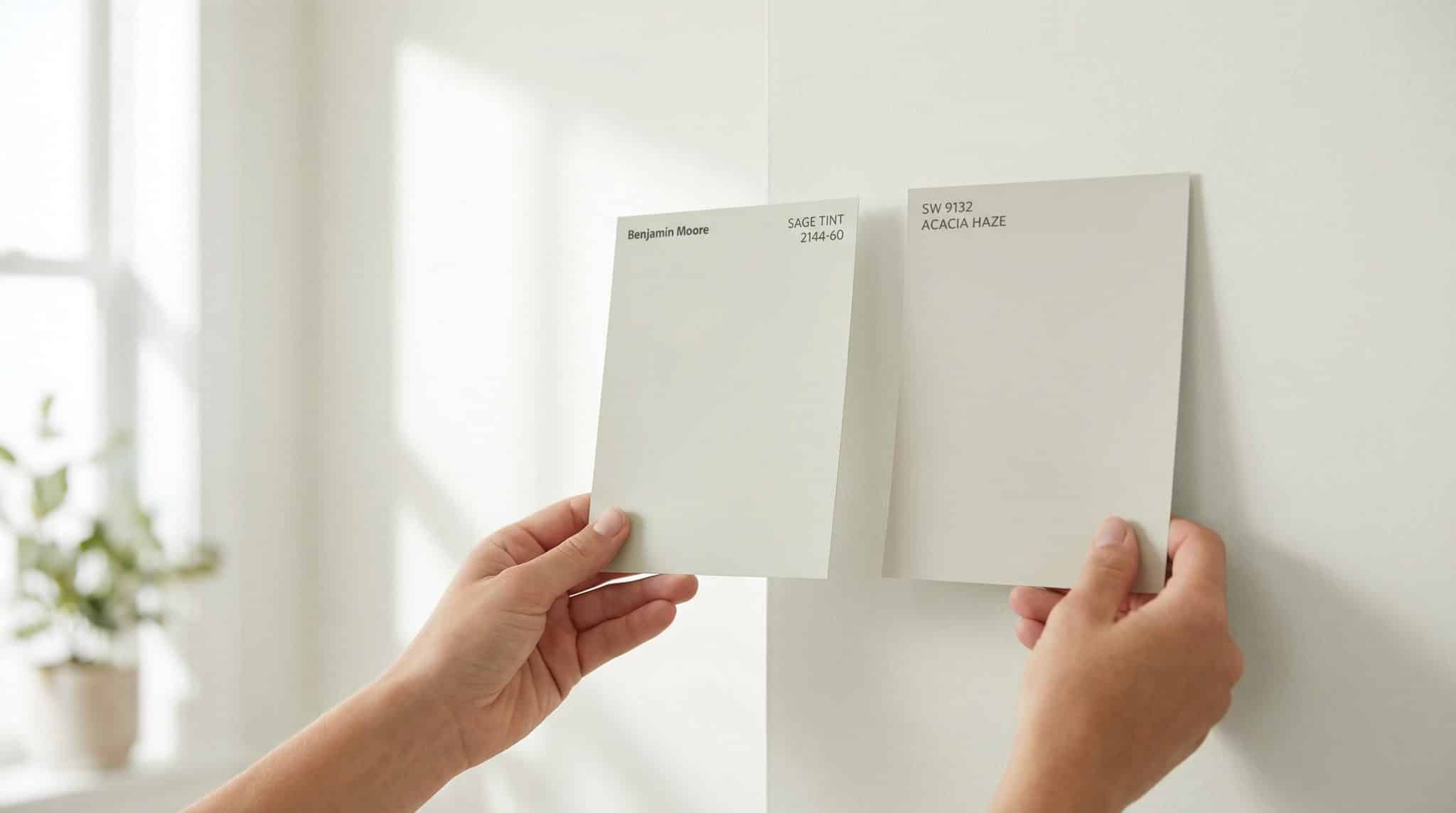
Benjamin Moore Matches for SW Sagey (That Actually Make Sense)
Sherwin-Williams Sagey (SW 6175) is one of those colors with a name that’s basically a liar. “Sagey” makes you think: soft green, cozy cottage, maybe a loaf of sourdough cooling on the counter.
In real life? It’s more like an off white that once stood near a sage plant and picked up a tiny whisper of green… plus a warm, yellow leaning undertone. Which is exactly why trying to find a Benjamin Moore “perfect match” can make you want to lay down on the floor with your fan deck as a blanket.
So here’s what I’d do if you want the Sagey vibe in Benjamin Moore without spiraling.
First: Are you sure you’re even dealing with Sagey?
Sagey has an LRV of 75, which puts it firmly in the “basically bright” category. If your walls look obviously green from across the room, there’s a decent chance you’re actually thinking of SW Contented (SW 6191) instead.
Contented is everywhere online labeled as “sage.” It’s also way deeper (LRV 52) and reads green faster.
Quick sanity check: pull up Sagey and Contented on your phone (I know screens aren’t perfect, but we’re just narrowing suspects here), and compare them to whatever you’re trying to match. If it looks green green, Sagey isn’t your guy.
Once you’re sure it’s truly Sagey, we can talk Benjamin Moore.
Why you’re not going to get a perfect match (and you’re not doing anything wrong)
Paint companies do not share pigments like they’re trading friendship bracelets. Benjamin Moore and Sherwin-Williams use different bases and formulas, so even if two colors look “the same” online, they can shift in real life especially with:
- different wall texture (smooth vs. orange peel drywall)
- different sheen (matte vs. eggshell can change everything)
- different lighting (the drama queen of home design)
Also: those RGB/hex “matches” floating around the internet? They’re estimates. Your screen is basically making it up based on vibes and brightness settings.
So instead of hunting a unicorn exact match, your goal is this:
Find the Benjamin Moore color that looks like Sagey in your room.
The Benjamin Moore colors I’d actually sample for a “Sagey ish” look
I’m going to keep this tight because you don’t need twelve maybes you need a couple strong contenders and a plan.
1) BM Halo (OC-46) the safest “most like Sagey” pick
If you want the closest overall lightness + softness + not too green but kinda thing, Halo is where I’d start.
This is the one I’d grab if:
- you’re trying to match Sagey used elsewhere in your house
- you want minimal surprises (because you have enough surprises in life, thanks)
2) BM October Mist (1495) for rooms that make warm paint go weird
If your room tends to make warm colors look a little… buttery (or you have warm bulbs that turn everything into “vanilla pudding”), October Mist is a solid alternative.
It keeps that calm, muted energy, but it’s built on a softer gray base, so it doesn’t lean as yellow as easily.
3) BM Rock Candy (CSP-225) for staying neutral when lighting is chaotic
Rock Candy is one of those “it just behaves” colors. If your lighting is inconsistent (hello, open concept + mixed bulbs + one sad lamp in the corner), this option can read more steady.
Think: Sagey’s quiet personality, minus some of the warm shift.
Want it greener on purpose?
If you’re sitting there thinking, “Okay but I do want people to notice there’s color on the walls,” then try BM Saybrook Sage (HC-114).
It’s the greenest of this bunch, and it can work especially well if your room gets a ton of daylight that washes pale colors out.
One I’d personally skip for a Sagey match
You might see BM Green Cove Springs (2034-60) pop up in match databases, but it tends to pull cooler and blue green, without that warm softness Sagey has. Next to warm wood, brass, or anything golden? It can look… off. (Like when you wear the wrong white shirt and suddenly you look slightly ill.)
If you’re matching Sagey interior color notes, I wouldn’t start there.
Lighting: the annoying part that decides everything
Here’s the “if this, then that” version without a spreadsheet and a Sagey and Sea Salt lighting comparison:
- North/east facing rooms (cooler, steadier light): start with Halo
- South facing rooms (warm light blasting in): try October Mist
- Super bright rooms that wash everything out: sample Saybrook Sage
- Warm bulbs (2700K-3000K): October Mist is usually safer
- Cool LEDs (3500K-5000K): Rock Candy can hold steady
If you only take one thing from this post, take this:
Lighting is basically a filter on your paint. It will change the whole story.
How I’d test it (without losing your weekend)
Those tiny paper chips? Cute. Useless. They’re like judging a movie by one frame.
Do this instead:
- Peel and stick samples (the 12×12-ish real paint ones) are amazing if you want low mess. Stick them up and live your life.
- Or paint samples onto poster board (two coats), and move them around the room like you’re holding auditions.
Where to put your samples
Tape them at eye level, about 3-5 feet from your main window. Then also try one on a wall that gets less light, because corners love to reveal the truth.
When to look (this matters)
Check them in:
- morning light
- midday
- late afternoon
- night, under your actual bulbs (the real test)
If a color looks perfect all day and then at night turns into “why is this yellow/gray/green in a haunted way,” that’s not you being picky that’s real life.
My two little “don’t hate yourself later” tips
1) Compare undertones with plain white paper
Hold your sample next to printer paper in daylight. You’ll spot the undertone immediately (yellow? gray? a hint of green?). Do the same with Sagey if you have it. Undertone match beats “sage” labels every time.
2) Don’t spot touch light colors and expect magic
Very light colors (LRV 70+) can show batch differences. So if you think you’ll do tiny touch ups later listen, I love your optimism. But you’ll usually get a better result repainting the whole wall than dotting it like a paint and pray situation.
What I’d do today if I were you
If you want the simplest path:
- Start with Halo and October Mist as your first two samples.
- If your room is ridiculously bright (or you want more visible color), add Saybrook Sage.
- Watch them through a full day and night cycle.
- Pick the one that looks right most of the time, not the one that looks right for five perfect minutes at 11:17 AM.
Because that’s the real goal: a color that feels good to live with, not a match that wins a microscopic side by side comparison you’ll never do again after painting.
When one of them just quietly works in every light? That’s your winner. Go paint.