
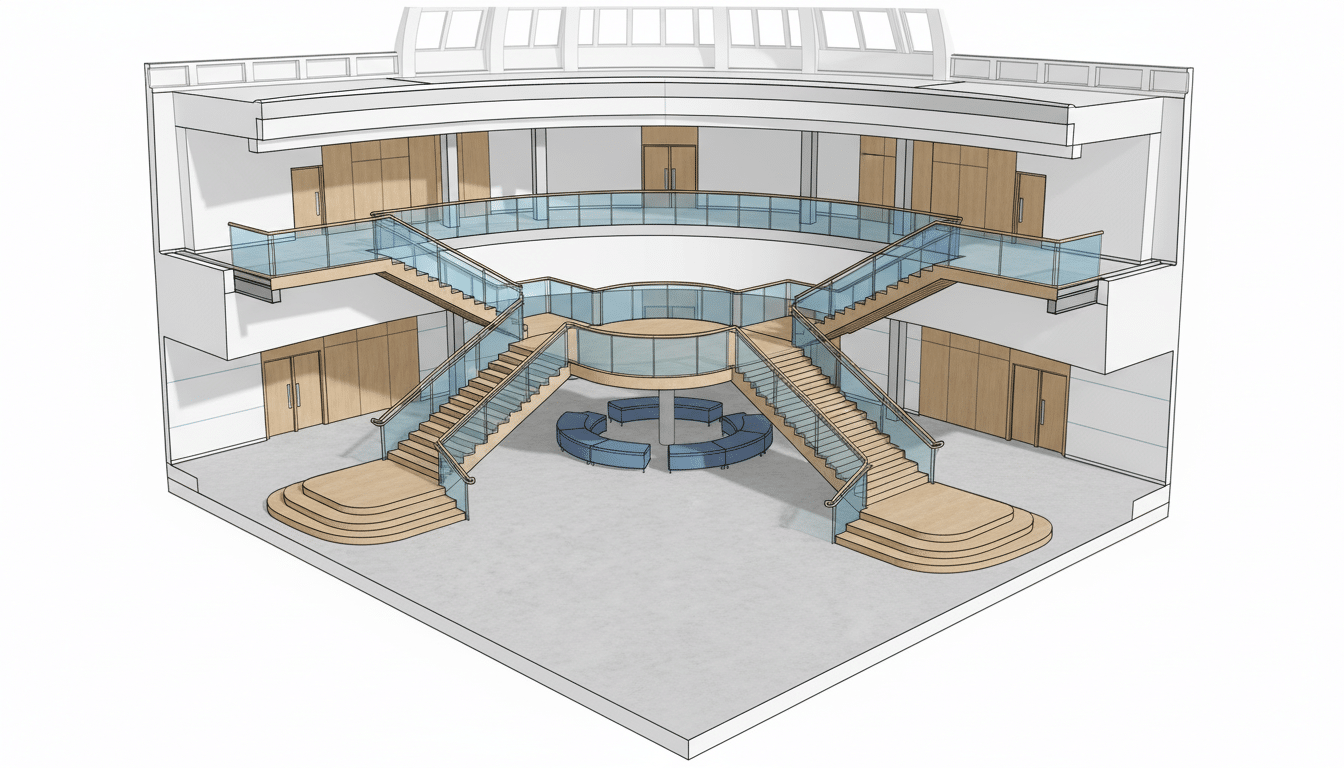
Bifurcated (aka “Split”) Stairs: What Everyone Learns After They’ve Fallen in Love
There are two kinds of people in the world:
- People who see a dramatic Y shaped staircase and whisper, “I want that.”
- People who have priced out a dramatic Y shaped staircase and whisper, “I used to want that.”
If you’re currently in Category #1, welcome. I’m not here to crush your dreams I’m here to keep you from designing a Titanic moment inside a foyer that’s basically a postage stamp.
Because bifurcated stairs are gorgeous. They’re also space hungry, custom, and wildly offended by tight floor plans.
Let’s talk about what they actually are, what they really cost (money and square footage), and how to tell if this is a brilliant choice… or a “why is my living room the size of a closet now?” choice.
First: “Split stairs” and “bifurcated stairs” are the same thing
If you’ve been googling both like they’re different species, you can stop. “Bifurcated” is just the fancy word for split.
It’s the classic layout: one wide run up from the foyer → a landing → then it splits left and right. It’s made to be an entrance. It is not made to be efficient. (This staircase does not care about your budget, your furniture layout, or your desire to have a coat closet.)
You’ve seen it in old estates, grand hotels, and every movie where someone descends the stairs in slow motion while life changing drama happens.
In a real house? It can be incredible if your house can actually handle it.
The part nobody wants to hear: the space is… a lot
Bifurcated stairs take up more room than basically any “normal people” staircase layout. Here’s the quick and dirty comparison:
- Straight stairs: ~40-60 sq ft
- L shaped: ~50-80 sq ft
- U shaped: ~60-100 sq ft
- Bifurcated: 120+ sq ft (and that’s the “on paper” version)
In real life, once you factor in landings and the fact that humans need to, you know, walk around the stairs, you’re usually looking at around 144 sq ft minimum—think roughly a 12′ x 12′ foyer/entry zone.
Can someone technically draw it smaller? Sure. People also technically wear jeans two sizes too small. Doesn’t mean it’s comfortable or a good idea.
Okay, but how much do these stairs cost?
Ballpark: $10,000 to $40,000+.
And yes, that range is rude. Welcome to custom construction.
A Y shaped staircase build often runs 2-3x the cost of straight stairs because:
- You’re not buying “stairs,” you’re buying a custom structural moment
- The split landing has real engineering going on (it’s taking loads from three directions)
- The railing situation is more complicated (and railings are sneaky expensive)
- Build time is typically longer (translation: more labor)
Also: retrofitting bifurcated stairs into an existing home is… not impossible, but it’s usually not the clean “swap the stairs” situation people imagine. Your structure has to support it in the right places, and sometimes it just can’t without major reworking.
When bifurcated stairs actually make sense (and aren’t just a pretty picture)
I’m not anti-bifurcated. I’m anti-forcing bifurcated. If your house checks the right boxes, these stairs can be a dream.
They shine when:
1) Your upstairs has two real destinations
If your second floor genuinely splits into two “zones” (like a primary suite wing on one side and kids/guest rooms on the other), the two upper runs can actually be useful—not just decorative.
2) Your entry is meant to be the star
If you have a two story foyer and the front door opens into a big, open “wow” space, bifurcated stairs can look like they belong there (instead of looking like they’re trying too hard).
3) You like the idea of less stair traffic awkwardness
Two people can pass without doing that weird shuffle where someone hugs the railing and pretends it’s totally fine.
4) You want a natural “break” in the stair run
That mid landing is not just for drama. It can also be a safety win—breaking up a long fall into shorter segments.
The “don’t even book the designer yet” checklist
If you want to avoid spending money just to be told “this won’t fit,” here’s what I’d personally confirm first:
- You’ve got the footprint (realistically ~12′ x 12′ of clear space, not “12′ if we count the area where the door swings and the dog bed lives”)
- Your foyer ceiling height is at least ~15 feet (these stairs need vertical drama or they feel squashed)
- Your entry is a focal point, not a hallway that happens to have a staircase
- Your upstairs layout benefits from splitting left and right (not just “it could, technically”)
- Your home style can carry formal symmetry (they look most natural in traditional, formal, or transitional homes)
- Your budget can handle custom stair pricing without stealing from the “roof, HVAC, and unexpected plumbing chaos” fund
- Mobility concerns aren’t a factor
- This one is big: stair lifts don’t love landings/turns, and the upper runs are often narrower (commonly 36″-44″ after the split), which can feel tight for anyone with balance issues.
If that last bullet applies to your household now—or might in the next several years—I’d pause hard before committing.
Red flags (a.k.a. when these stairs will bully your floor plan)
Personally, I’d skip bifurcated stairs if:
- Your home is under ~2,500 sq ft (it usually steals too much space from the rooms you actually use)
- Your style is mid century, minimalist, cottage, ranch, etc. (the formal symmetry can feel like it crash landed in the wrong movie)
- Your upstairs is basically one open blob with no clear left/right “wings” (then you’re paying for two routes you won’t use)
If you’re trying to squeeze this into a tight entry, you may end up with a staircase that’s technically there… but makes everything around it feel smaller and awkward. And then you’ll resent it every time you carry groceries inside.
My favorite alternatives when you still want a “moment” (without the headache)
If you love the vibe but not the space/cost, these give you a lot of payoff:
L shaped stairs
Often the best compromise. You get a turn and a landing (which looks more custom than straight stairs) and they can work in smaller foyers. They typically use 35-50% less floor area and can cost about half as much.
U shaped (switchback) stairs
Great when your layout is narrower and you need to stack the runs efficiently. Still classic, still substantial, just not as “grand hotel lobby.”
Straight stairs with a landing
The practical MVP. Simplest to build, usually easiest to permit, and can still look amazing with the right railing, lighting, and wall treatment.
(And yes: you can absolutely make “basic” stairs feel high end. I have seen a gorgeous runner and a killer light fixture do miracles.)
Quick code reality check (before you get emotionally attached)
I’m not your building department, and codes vary by location, but here are a few common “surprises” with stair landing compliance basics with bifurcated stairs:
- The split landing needs to be appropriately sized for safe turning (often at least ~3 feet deep)
- A wide lower run may require additional handrails depending on width (sometimes even a center handrail)
- Long rises/long runs may require intermediate landings regardless of style (for example, if rise exceeds around 12 feet or you’ve got 16+ steps in a row—again, depends where you live)
If you’re serious about this staircase, do yourself a favor and follow this order:
- Measure your foyer and ceiling height
- Sketch where the two upper runs would actually land upstairs
- Talk to your local building department or a pro about basic feasibility
- Only then start picking finishes and requesting real bids
This saves you from the heartbreak of choosing your “dream railing” and then learning your foyer is approximately three feet too small.
The honest bottom line
Bifurcated stairs are the diva of residential staircases: stunning, dramatic, and absolutely not interested in compromising.
If you have the space (think 12′ x 12′ minimum), the ceiling height (15’+), the right upstairs layout, and the budget, they can be a showstopper in the best way.
If you don’t? You’re usually better off with an L shaped or U shaped stair and spending the leftover money on something you’ll enjoy every single day—like better flooring, prettier lighting, or a front door that doesn’t stick when it rains (ask me how I know).
If you do one thing tonight, do this: measure your foyer’s clear rectangle and ceiling height. Those two numbers will tell you so much before you spend a dime dreaming.