
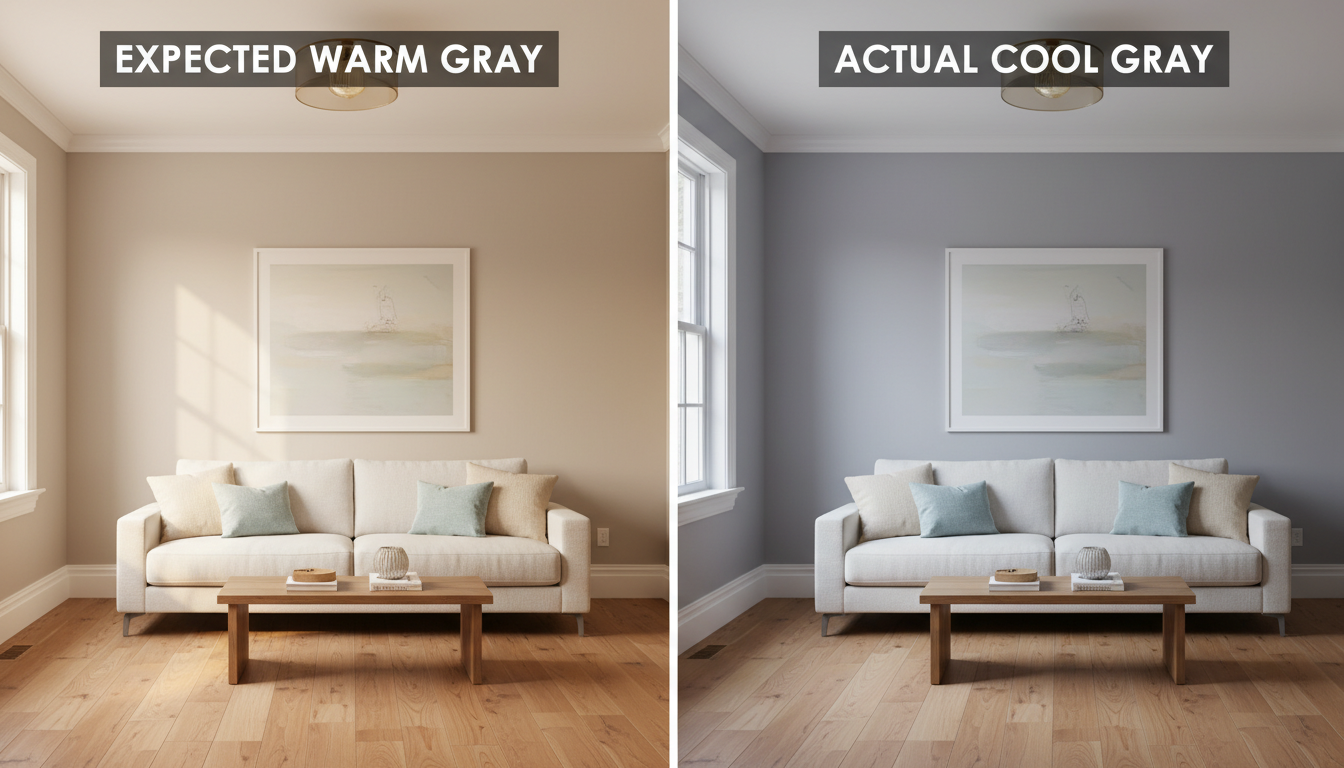
Classic Gray in North Facing Rooms: What No One Tells You (Until You’ve Bought 3 Gallons)
Classic Gray (Benjamin Moore OC-23) is one of those paint colors that gets passed around like a family recipe. “It’s perfect! It goes with everything! It’s basically magic!”
And then you put it in a north facing room and suddenly it’s giving… mysterious lilac shadow depending on the hour, the weather, and whatever mood your house is in that day. Ask me how I know.
So let’s talk about what actually happens with Classic Gray in cool north light, when it’s gorgeous, when it’s a lil’ rude, and how to test it so you don’t end up rage painting at midnight.
Why Classic Gray Acts Like a Different Color in a North Room
North facing light is basically nature’s softbox… if the softbox was set to cool and moody. It’s indirect, it’s bluish, and it doesn’t give you that warm sunny “golden hour glow up” that south facing rooms do.
Classic Gray is a very light color (its LRV is 74.8, which is paint nerd speak for “it reflects a ton of light and often looks off white”). And because it’s so subtle, its undertones have a lot of influence.
Here’s the important part:
- Classic Gray has a quiet warm side (a little greenish warmth that usually behaves)
- and a soft violet undertone that can pop out in cooler light
In a warm, sunny room, that violet gets calmed down and the color reads more like a cozy, barely there greige. In a north room, there’s less warmth to “filter” it, so that violet can be more noticeable.
This isn’t a “bad batch of paint” situation. It’s just… paint doing paint things.
North Light Through the Day (AKA: The Vibe Doesn’t Change Much)
One reason north rooms are tricky is also why they’re kind of predictable: the light stays fairly consistent. You’re not getting huge warm swings like you do with east or west windows.
- Midday is your truth serum. That’s when north light is doing its most north light ish thing: cool, soft, slightly muted.
- Evening is when your bulbs take over, and that can make or break Classic Gray.
- Overcast days are the ultimate test. If you like it when it’s gloomy outside, you’ll probably like it always.
Personally? I actually like Classic Gray in a lot of north rooms because it’s not a yellow cream situation. Creams can go weirdly muddy up north. Classic Gray at least tries to stay clean.
The Make or Break Factor: How Bright Your “North Room” Actually Is
Not all north facing rooms are created equal. A north room with big windows and open sky outside is basically a bright, flattering Instagram filter.
A north room with one sad window, a porch overhang, and a giant tree parked in front of it? That’s a cave with opinions.
Here’s my favorite quick test (because I’m lazy efficient):
The “Can You Read a Book?” Test
At around 2 PM on an overcast day, can you read small print at arm’s length without turning on a lamp?
- Yes: Classic Gray has a decent shot at looking soft and pretty.
- No: It may look flatter, cooler, or more “why is my wall faintly purple?” than you wanted.
When Classic Gray Disappoints (So You Don’t Feel Personally Attacked)
Classic Gray is lovely… but it has a few situations where it tends to flop.
1) Your room is too dim
Heavy tree cover, deep overhangs, tiny windows Classic Gray can lose that gentle warmth and start looking dingy or violet-y.
2) Your room is too bright
If you’ve got huge windows or you’re up high with tons of open sky, Classic Gray can wash out to basically off white. If you actually want to see “gray,” you might be annoyed.
3) You’ve created a “cool tones only” pileup
Cool gray sofa, cool counters, silvery metals, icy lighting… and then Classic Gray shows up and goes, “Cool, I’ll bring my violet friend too.”
4) There’s a lot of greenery right outside
A wall of shrubs can reflect a green cast into the room, and Classic Gray will sometimes pick that up. (It’s not haunted. It’s just color theory being dramatic.)
If You’re Already Side Eyeing It: A Few Alternatives I Actually Like
If you want to stay in the same general neighborhood but skip the “will it go purple?” suspense:
- If your north room is dim and needs more cozy warmth: Pale Oak or Edgecomb Gray
- If your room is bright and Classic Gray disappears: Gray Owl (more pigment, still plays well in north light)
- If you want a more obvious greige/taupe look: Agreeable Gray (Sherwin Williams)
No paint color is perfect, but these are the ones I’d pull first if Classic Gray is making you nervous.
How to Test Classic Gray Without Lying to Yourself
A tiny little 12×12 swatch is not a test. It’s a paint flirtation. You need a real commitment situation.
Here’s what works (and yes, it’s slightly annoying, but so is repainting an entire room):
1) Buy a quart and go bigger than you think.
Paint a big section or a whole corner. Classic Gray is subtle you need space to see what it’s doing.
2) Test 3 spots:
- the wall you see most (often opposite the window)
- the window wall
- the darkest corner (this one tells the truth)
If you can live with it in the darkest corner, you’re probably good.
3) Live with it for a few days.
Check it morning, midday, and at night with your lamps on. Bonus points if you get both sunny and cloudy weather.
4) Tape up a “real white” next to it.
I like Chantilly Lace as a reference. A true white nearby makes it much easier to see whether Classic Gray is reading warm, cool, or “hello, faint lavender.”
Trim + Sheen: The Sneaky Stuff That Changes Everything
In north rooms, sheen matters more than you think because you’re fighting for light.
- Eggshell is my go to for walls most of the time.
- If the room is a bit darker, satin can help bounce light around without looking shiny gymnasium.
For trim: go a little glossier (semi gloss is the usual move). That extra contrast helps Classic Gray and White Dove in a cool room feel less flat.
Trim colors I like with Classic Gray in north rooms:
- White Dove (warm enough to soften the coolness this is a favorite)
- Simply White (also warm leaning, but still crisp)
- Chantilly Lace (clean and bright, but it’ll make Classic Gray look more “gray” by comparison)
One thing I’d personally avoid: creamy/yellow white trim with Classic Gray in a north room. That combo can nudge the undertones into pinky territory, and it can start to feel a little… 2006 builder beige adjacent.
Don’t Let the Room Turn Into a Cold Waiting Room
Classic Gray can look super elevated in north light, but you’ve gotta give it a few warm friends so it doesn’t feel like a dental office.
My quick “warm it up” hits:
- Warm metals: brass, bronze, copper (instead of all chrome everything)
- Warm woods: even a little oak or walnut moment helps
- Textiles: creams, sands, warm linen tones (not just a pile of cool grays)
And please, for the love of cozy: pick the right bulbs
At night, your lighting is basically in charge.
- 2700K: warm + cozy, great if your room feels chilly
- 3000K: my favorite middle ground (warm but not yellow)
- 4000K and up: usually makes Classic Gray look cooler and more “office”
If you can, do 3000K on a dimmer and use a couple lamps instead of one harsh overhead. Shadows are not your friend in a north room.
The “Should I Actually Use Classic Gray?” Reality Check
Classic Gray is a yes if:
- your north room gets decent steady daylight
- you want “soft almost white greige,” not a statement gray
- you’re pairing it with warmish trim and a little warmth in the decor
- your test patch looks good even on a cloudy day
Classic Gray is a no if:
- the room is dim and you’re already fighting darkness
- you have super creamy trim you can’t change
- you want the wall color to clearly read as “gray”
- your sample keeps going violet/cool in a way you can’t unsee (because you won’t unsee it, ever)
My Final Take
Classic Gray can be absolutely beautiful in a north facing room… if your room has enough light and you don’t style it like an all gray iceberg. The “surprise violet” thing isn’t a myth it’s just how undertones shift in light.
Do yourself a favor: paint a big test patch, live with it for a few days, and check it at night under your actual bulbs. If you still love it? Congrats, you found a neutral that looks expensive without trying too hard.
And if you don’t love it? Also congrats you just saved yourself from painting the whole room and whispering “why is it purple” every time you walk by.