
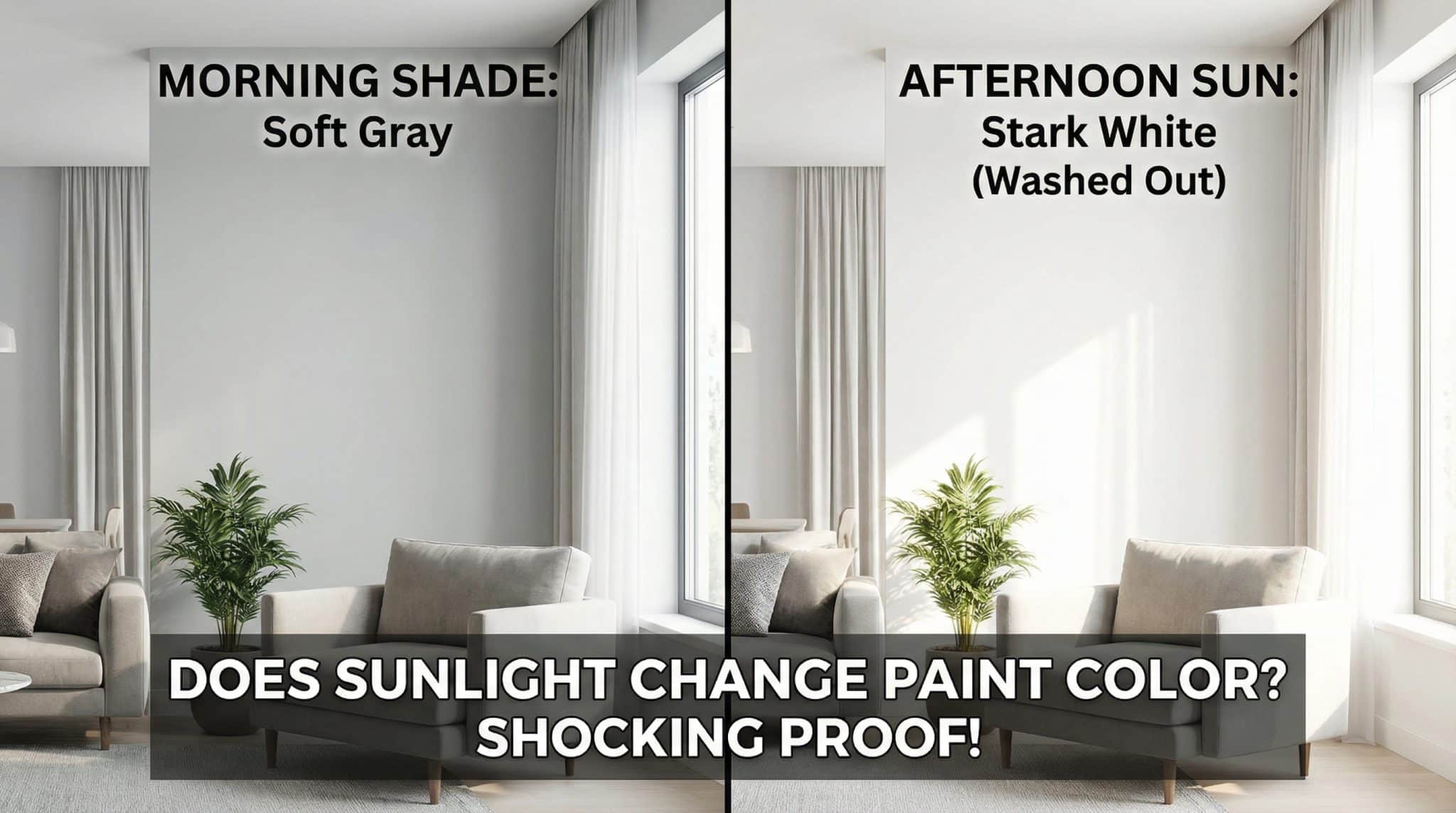

Why Sunny Rooms Make Your Paint Disappear (and How to Stop the Sun From Winning)
You know that dreamy, barely there greige you fell in love with on a tiny store chip? The one that promised “soft warmth” and “calm sophistication” and probably a better life overall?
Yeah. Then you put it on your sun blasted living room wall and by noon it looks like… regular white. Like you paid good money to reinvent primer.
That, my friend, is paint washout and it’s not you being dramatic. Bright light (especially south/west light) can absolutely bully pale paint into disappearing. The good news: you can prevent it without giving up on light, airy walls. You just need to stop choosing paint the way most of us do (standing in an aisle, squinting at chips, slowly losing the will to live).
Here’s what actually matters: LRV, window direction, finish, and testing like you mean it.
So what is paint washout?
Paint washout is basically when a color doesn’t have enough visual “weight” to stand up to intense sunlight. Super light paints have less pigment, so in a bright room they don’t show their undertone as clearly they just reflect light back at your face like a polite flashlight.
The paint didn’t betray you. The light did.
(If it makes you feel better, I once watched the prettiest soft gray turn into “dentist office white” in a south facing room. The homeowner was convinced the store mixed the wrong color. Nope. The sun was just being extra.)
The number you should actually care about: LRV
LRV = Light Reflectance Value, aka how much light a color bounces around. Scale is 0 (black) to 100 (white).
Here’s the thing: lots of advice online pushes super high LRV like 80+ because “bright and airy!” And sure, that’s fine… until your room is basically a solar panel. In a really sunny space, high LRV paint can look white because it’s reflecting so much light that the undertone can’t hold on for dear life.
My general rule for bright rooms:
- Sweet spot: LRV 60-75
- Proceed with caution: 75-84
- In very sunny south/west rooms: 85+ is often “why are my walls white?” territory
If you want the quick and dirty version:
- LRV 85+ = likely washout in strong sun
- LRV 60-74 = still light, but it usually reads like an actual color
- LRV 50-59 = even safer if your room gets blasted with sunlight all day
You can usually find LRV on the manufacturer’s site (and sometimes on the back of the paint chip).
Your windows are running the show (sorry)
You can have the best taste in paint colors. Your windows do not care. Here’s the cheat sheet:
South facing rooms: bright, warm, and ruthless
This is where pale colors go to be erased.
- Keep LRV around 70 or lower if you want to still see color midday
- I usually lean cooler undertones (soft gray, blue gray, gentle green) to balance the warmth
- Skylights make this even more intense—if you have them, consider dropping closer to LRV 65-ish
West facing rooms: the golden hour glow… all afternoon
West light gets intense and can turn warm neutrals kinda… snack cheese colored by 4pm.
- I’d keep it around LRV 70-75 max
- Cooler/neutral undertones tend to behave better here
East facing rooms: the “I’m not trying to ruin your life” light
Warm in the morning, cooler later. Much easier to work with.
- You can often go up to LRV 75-82
- Warm or neutral undertones usually play nicely
North facing rooms: not washout more like “why is this sad?”
North light is cool and can make pale paint look dull or icy without warm shades for north light.
- Warm undertones help a ton (creams, warm grays)
- Higher LRVs are usually fine here because you’re not fighting washout you’re fighting “blah”
One more sneaky thing: what’s outside your window matters.
Green landscaping can throw a green cast. Red brick can warm everything up. White exterior walls or a pool can bounce extra light inside like a disco ball of doom.
Want a simple fix? Choose the right finish.
If your room is super bright and you’re using a pale color, do yourself a favor and go matte (or flat).
Matte paint scatters light instead of bouncing it directly back at you, which helps the color stay visible. Shinier finishes especially satin and semi gloss can make washout worse because they reflect light like a mirror.
My opinionated take:
- Matte walls in sunny rooms = yes, always, love you, mean it
- Save satin/semi gloss for trim unless you genuinely enjoy watching undertones vanish in real time
(And yes, modern matte paints are way more durable than they used to be. No, your walls will not instantly disintegrate if someone looks at them.)
A few paint colors that don’t immediately ghost you in bright rooms
Obligatory note: every house is different, your flooring is a whole personality, and paint is basically sorcery. But these are decent starting points.
For south facing rooms (aka the sun arena)
- Benjamin Moore Stonington Gray (LRV 59) — holds up well in bright light; can feel cool if your decor is very warm
- Benjamin Moore Gray Owl — a readable cool gray in bright rooms (test it, because it can skew cooler depending on surroundings)
- Benjamin Moore October Mist (LRV ~75-77) — pretty, but on the higher end; absolutely test it at noon
For west facing rooms (golden but make it aggressive)
- Benjamin Moore Pale Oak (LRV 70) — warm greige that usually avoids the “why is this yellow?” trap
- Soft blue grays / cool grays — great for fighting the golden shift, but make sure your nighttime bulbs aren’t icy
For north facing rooms (bring the warmth)
- Benjamin Moore Navajo White (LRV 78) — warm and creamy; will read more yellow with warm bulbs
- Swiss Coffee — classic warm off white that keeps north rooms from feeling sterile
If your room is bright south/west, I’d be careful with:
- pure whites (LRV 90+) if you want a “color” (because you may not get one)
- very warm creams with obvious yellow undertones (they can go full butter in harsh sun)
How to test paint without getting lied to by a tiny swatch
Paint testing is annoying. I get it. But you don’t need 47 samples you need a better method.
Here’s what works:
-
Paint a BIG sample
At least 12″ x 18″ (bigger if you can). Two coats. Let it dry a full day. -
Put it on the wall that gets blasted with sun
Don’t test behind the sofa in the dim corner and then act shocked later. The sun corner is the courtroom test your paint there. -
Check it at three times
- Morning (around 7-8am): cooler, undertones show up
- Midday (12-1pm): peak washout, your worst case scenario
- Late afternoon (4-5pm): warm shift (especially west rooms)
-
Do the white paper test at noon
Hold a pure white sheet/card next to the sample.
If they look almost identical, you’ve got washout. If you can still clearly say “warm gray” or “subtle soft green” at noon, you’re in good shape.
Bonus points: leave it up a few days so you see overcast light too.
If your walls already washed out, don’t panic (yet)
Before you repaint your whole life, try these first:
-
Swap your bulbs
If your walls look flat at night, warmer bulbs can help a ton. I like 2700K-3000K for most living spaces. -
Add contrast
Mid tone furniture (taupe, charcoal, navy) gives your eye something to compare against. Pale walls next to pale everything = the walls vanish. -
Pull lighting off the walls
A couple lamps 3-4 feet away from the wall can reduce that “flat sheet of light” effect. -
If you repaint, go matte
Seriously. It’s the easiest upgrade for a sunny room.
Also: if you tested when the room was empty, that can mess with you. Once rugs, curtains, and furniture move in, light bounces differently. Paint is nosy like that.
The tiny plan that saves you from repainting twice
If you do nothing else, do this:
- Figure out your room direction (south/west/east/north)
- Choose a color with an LRV that makes sense for that light
- Pick a matte finish for sunny rooms
- Test big and judge it at noon like the skeptical adult you are
Your sunny room doesn’t have to eat your paint color alive. You just need to stop handing the sun an easy win.