
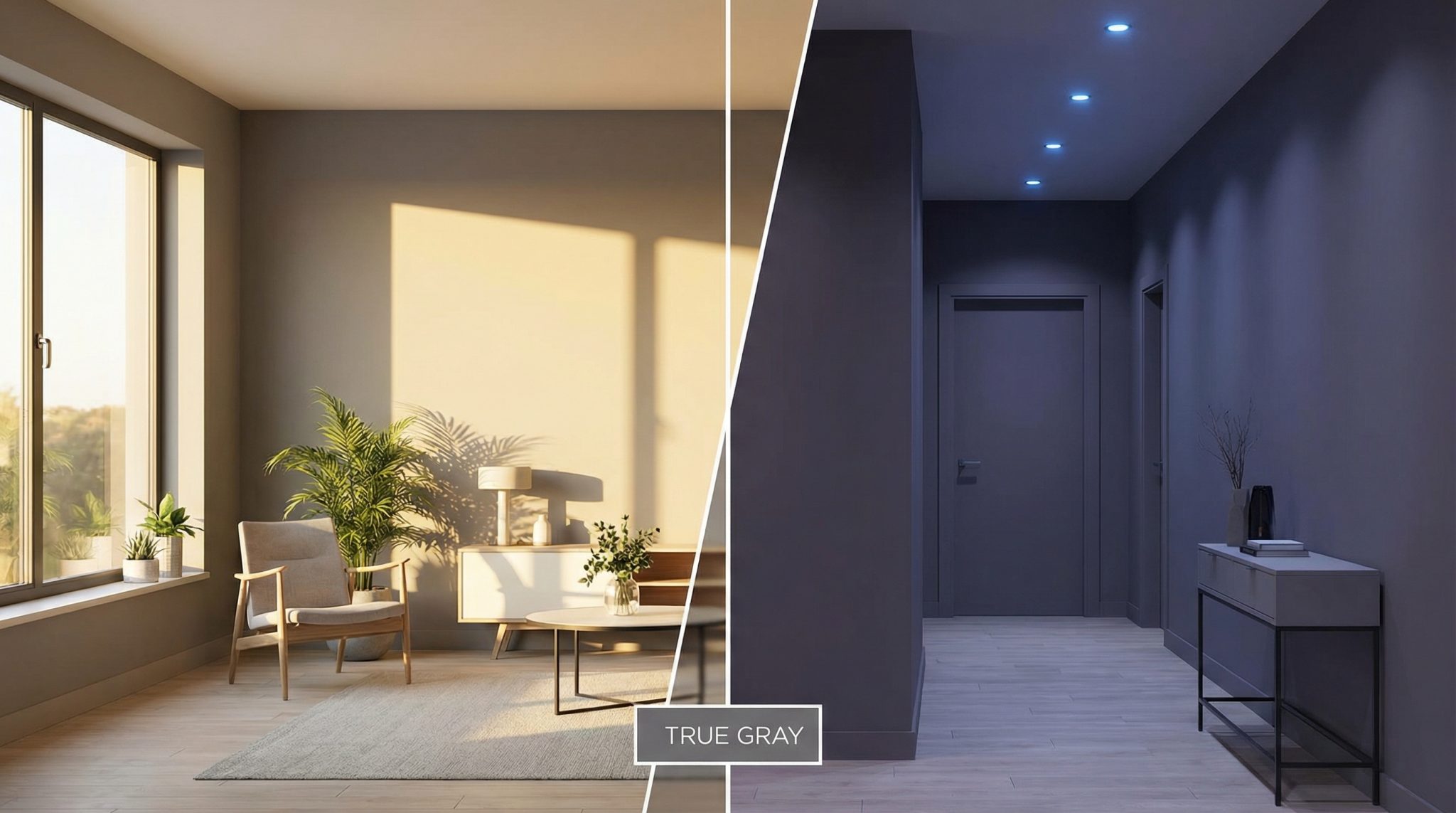

You know that dreamy greige you fell in love with under the store lights? The one that looked calm, chic, and vaguely like you have your life together?
And then you painted it at home and surprise it’s beige in the living room, kind of purple in the hallway, and somehow… greenish at night. Fun! Love this journey!
You’re not imagining it. The paint isn’t “bad.” Your house is just doing what houses do: throwing different light at the same color and watching you spiral.
Paint is basically a mirror with commitment issues. It reflects whatever light hits it, and light changes all day long. That’s the plot twist no one tells you when you’re standing in aisle 7 holding 14 sample cards like you’re about to solve a crime.
So let’s talk about why it happens, and how you can test paint in a way that doesn’t end with you repainting the same wall three times and whispering, “I hate everything” into your roller tray.
1) Paint Isn’t Lying. Light Is Just Dramatic.
Paint doesn’t create color. It reflects light. Change the light, and the color changes like your walls are doing outfit changes behind your back.
Here’s what makes it extra annoying: daylight itself isn’t consistent. Morning light is cooler/bluer. Evening light is warmer/golden. So the “same” wall can honestly look neutral at noon and oddly warm by dinner.
Want a quick reality check before you blame the paint and start rage Googling “why does my paint look purple” at 11 pm?
Do this today:
- Look at your wall at midday with all the lights off.
- Look again at night with your usual lamps on.
If it feels like two different colors, congrats you’ve discovered the real culprit: lighting, not your sanity.
2) Undertones: The Secret Ingredient Nobody Asked For
Most paint heartbreak is undertones. Lighting just turns the volume up in any Sherwin Williams warm taupe review.
That “neutral” gray? It’s rarely neutral. It’s usually hiding a little blue, green, purple, or (my personal nemesis) pink. And depending on your room, that undertone will eventually come stomping in like, “HELLO I LIVE HERE NOW.”
Here’s my favorite quick undertone test (it takes 10 seconds and saves years off your life):
- Hold the paint chip up to a sheet of bright white paper.
- Whatever extra tint suddenly jumps out at you? That’s the undertone.
Also: line up a few similar chips side by side (same general color family). The differences you see are usually undertones. Once you start noticing them, you can’t unsee them. Consider yourself warned.
3) Your Windows Are the Mood Lighting Director
Window direction matters. A lot. It’s basically the “filter” your room lives under all day.
Here’s the cheat sheet I wish came with every paint sample:
- North facing rooms: Cooler, steadier light. Warm colors can look… not as warm as you dreamed. If you want cozy, you usually need to go a touch warmer than you think.
- South facing rooms: Bright, generous light most of the day. A lot of colors behave nicely here (even darker ones). Just know that super bright whites can look a little intense.
- East facing rooms: Pretty morning light, then it fades and flattens out later. A color that looks perfect at 9 AM can look “meh” by dinner.
- West facing rooms: Softer mornings, then BAM golden afternoon sun. Warm colors can get extra spicy (sometimes too spicy). Cooler tones often balance that glow better.
Also, inside one room, different walls can look different because the light hits them differently. Same paint. Same can. Different vibe. Your walls aren’t conspiring against you; they’re just… existing in geometry.
4) Nighttime Lighting: The Plot Twist You Actually Live With
Here’s the thing: you don’t live in your house at noon like a serene catalog person. You live in it at 7:30 PM with lamps on, snacks nearby, and at least one person asking where their shoes are.
So your light bulbs matter. A lot.
In general:
- Warm bulbs (2700-3000K): Cozy and golden. They make warm undertones louder and can make cool colors feel dull or muddy.
- Neutral bulbs (around 3000-3500K): My “most homes look normal” sweet spot. If your colors keep going weird, swapping bulbs is a cheap experiment before repainting.
- Cool bulbs (4000K+): Crisp, sometimes a little “office waiting room.” They pull cool undertones forward and can make warm colors feel flat.
- High CRI bulbs (90+): If you’re serious about color, these help a ton at night. They show color more accurately, so your paint stops looking like it’s in witness protection after dark.
And if you have dimmers? Test paint with the dimmers set where you actually keep them. Low light makes colors look deeper and moodier. (Ask me how I learned that one the annoying way.)
5) Your Decor Is Also Messing With Your Paint (Because Of Course It Is)
Paint doesn’t exist alone. Your floors, furniture, counters, and trim all influence how you see wall color because colors bounce around like a chaotic group chat.
If your floor has orange-y warmth and your paint leans cool/blue? They’re going to fight. Every day. Forever. No amount of cute throw pillows will fully broker peace.
If you’re trying to figure out why the paint feels “off,” do this little background check:
- What are your fixed elements? (Floors, cabinets, counters, tile, trim.)
- Are they warm or cool?
- Is your paint in the same general undertone family?
If there’s a conflict, the floor usually wins. It’s big, it’s everywhere, and it does not care about your Pinterest board.
6) How to Test Paint Without Losing Your Mind
Those tiny paint chips? They’re basically flirting. Testing on the wall is the relationship.
If you’re going to sample, go bigger than you think:
- Aim for at least a 12×12-ish area (bigger is better).
- Test on multiple walls if you can: one near the window, one across from it, and one interior wall.
- Look at it in the real moments of your day: morning, midday, late afternoon, and night.
My favorite “save your walls” method:
- Paint two coats on a piece of cardstock or poster board.
- Move it around the room like you’re auditioning it in different lighting.
- Tape it up and live with it for a few days.
And yes, give it at least 24 hours to dry before you decide it’s “wrong.” Fresh paint can shift as it dries, and the only thing worse than repainting is repainting because you panicked too early.
7) Before You Repaint, Try the Cheap Fixes First
If the color feels wrong, don’t immediately jump to “I must repaint the entire house and also move.”
Try this order:
1) Standardize your bulbs (same Kelvin temp throughout the space helps a lot).
2) Check the undertone against real whites in your room (trim, counters, tile).
3) Look for decor clashes (especially floors).
4) Then decide if it’s truly a paint problem… or a lighting problem.
Repainting is a commitment. Like bangs. You can do it, but let’s not do it impulsively without a premium paint line value check.
One Last Thing: Your Eyes Need a Minute
This part is annoying, but true: sometimes you just need time to adjust.
Your brain recalibrates. A new color can feel “wrong” simply because it’s different. I’ve had rooms I hated on day two and liked by week two once the shock wore off. (And I’ve had rooms I tried to talk myself into loving… and nope. Still hated. Paint jail.)
If you can stand it, give a new color a week or two of real life before you make the final call.
So… Why Does Your Perfect Paint Look Wrong?
Usually it’s one of these:
- the light in your room is changing the color (because it always does),
- the paint has a sneaky undertone you didn’t notice under store lights,
- your bulbs are rewriting the color at night,
- or your floors/fixed elements are pulling it in a weird direction.
The fix isn’t buying 27 more samples out of panic. It’s testing smarter, checking undertones, and paying attention to your lighting like the controlling stage manager it is.
Now go paint a big sample, look at it at night, and make that color tell the truth.