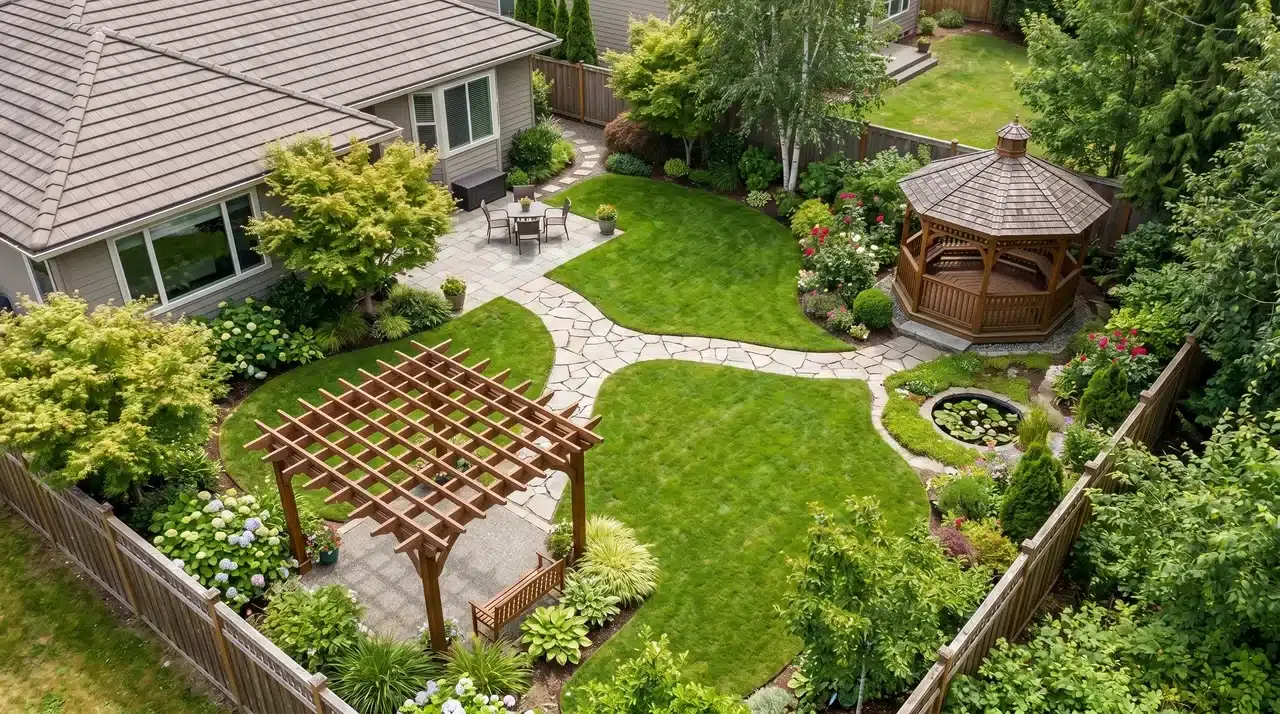
I’ve watched a lot of homeowners get stuck on the pergola vs. gazebo decision. The choice looks small until you realize it changes how you use your yard every day.
The roof is what separates the two. One lets the sky in, while the other closes it off completely.
That single choice affects your shade, your maintenance, and how much you’ll actually use the space when the weather turns.
Differences Between Pergola vs. Gazebo
The core difference between a pergola and a gazebo is the roof. One is open by design, the other fully enclosed.
Every other difference, like shade, weather protection, maintenance, and cost, follows from that one fact.
A pergola’s open roof lets light and air move through freely. You get partial shade, a light breeze, and a view of the sky, even while sitting underneath.
Pergolas are usually rectangular, and most attach directly to the house.
Because the roof is open, weather protection is minimal. How much you use it depends on your climate and the time of day.
A gazebo has a solid, peaked roof. It blocks sun, rain, and airflow completely unless the sides are open.
That gives you full shade and reliable weather cover. It works like a self-contained space in your yard.
Gazebos are usually freestanding, and most are round or octagonal, so they need their own dedicated footprint.
The solid structure gives more consistent use, but it changes how the space fits into your yard’s layout.
A pergola’s open roof lets rain pass right through. A gazebo’s solid roof has to carry weight, manage runoff, and hold up under a stronger structure.
How is Each Structure Built?
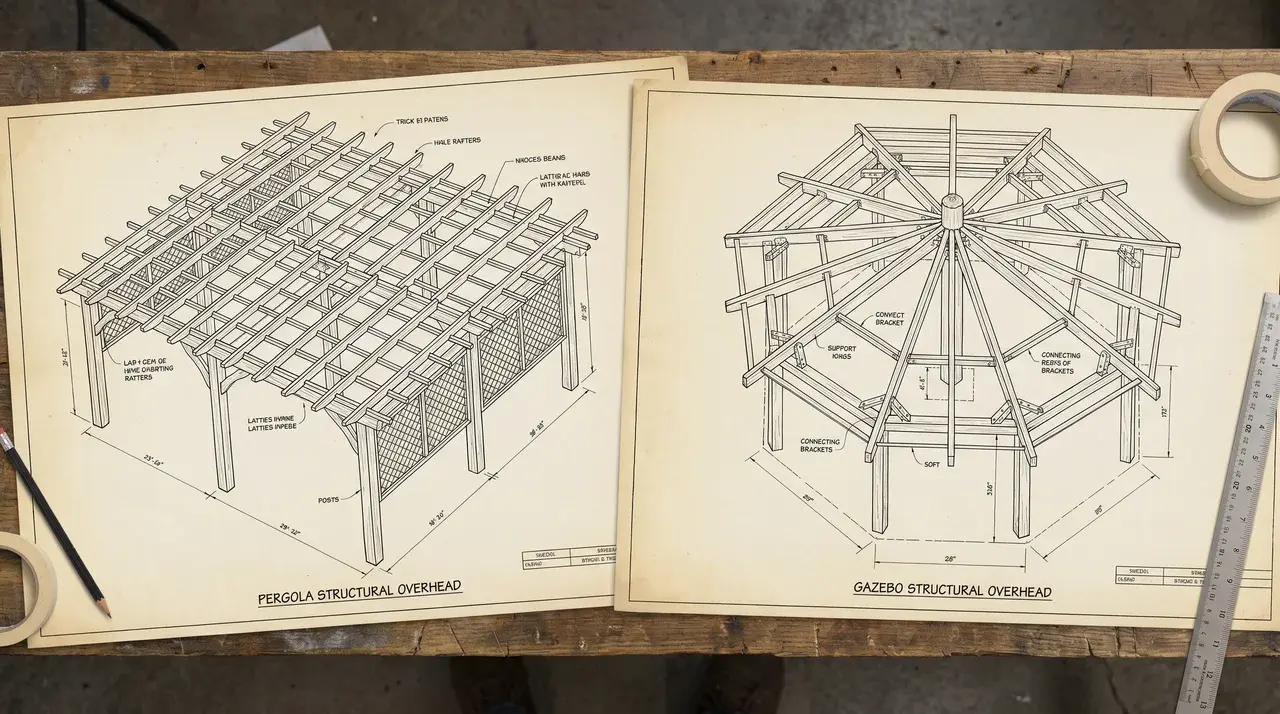
The real question is whether there’s a roof deck carrying weight.
That one fact decides where each structure can go and how it connects to your house. It also affects what expansion costs you down the line.
Pergola Construction Basics
A pergola uses a post-and-beam system. Vertical posts support horizontal rafters, with no roof deck or load-bearing structure above it.
It can attach directly to a house, sit on concrete, or extend with additional bays.
Adding a single 8-foot bay usually doesn’t touch the original footings. That means you can expand later without rebuilding what’s already there.
Gazebo Construction Basics
A gazebo is built to support a solid roof. Its frame is typically six- or eight-sided, fully self-supporting, and built for durability.
Unlike a pergola, a gazebo almost always sits freestanding on its own foundation. It can’t attach to walls or patios without major structural work.
Where Do Louvered Pergolas Fit?
A louvered pergola uses motorized or manual aluminum slats. The slats open to let in light and air, or close to block rain and direct sun.
When closed, the slats handle light rain about as well as a solid roof. When open, airflow feels just like a standard pergola.
Pricing sits between standard pergolas and custom gazebos, giving you weather flexibility without losing open sightlines.
Strengths and Limitations of a Pergola and Gazebo

A pergola is the right call for outdoor dining. A gazebo is the right call for outdoor living in wet weather. But those are the easy cases. Most people get stuck somewhere in the middle.
Pergola Strengths and Limits
Pergolas work best when you want partial shade. Open roofs let sunlight shift through the day, brightening mornings and shading afternoons.
Climbing vines grow naturally along the frame without blocking your yard’s sightlines.
The main limitation is weather. Light rain clears the space fast, and slatted roofs give little summer cover.
If it rains often or you entertain a lot, the pergola can sit unused.
Gazebo Strengths and Limits
A gazebo works like an outdoor room, with a solid roof that holds up against rain.
That makes it a good fit for hot tubs, kitchens, or anything needing steady protection.
Limitations include footprint and visual weight. Gazebos stand as separate structures and can feel bulky on small lots.
The peaked roof also collects debris that needs regular clearing.
Cost, Maintenance, and What Affects Each?
Cost varies more by material and build type than by structure category. So the pergola vs. gazebo price gap isn’t as fixed as most people assume.
Cost
Basic wood pergolas run $400 to $800. Louvered aluminum versions cost more, typically $2,000 to $3,500.
Price reflects material, size, and extras like motorized slats or weatherproofing.
Gazebos range from $350 to $700 for steel kits, and $1,200 to $2,500 for wood. Solid roofs and foundations raise installation costs, and long-term upkeep adds to the total.
Maintenance
Pergolas need minimal upkeep because the open roofs let debris fall right through.
Material matters most: wood needs annual sealing, while aluminum or vinyl needs none at all.
Gazebos need more attention. The solid roof needs periodic inspection, gutters or drainage channels need clearing, and steel parts need rust checks.
Key Differences at a Glance between Pergola and Gazebo
Use this table to check your priorities against each option before you decide.
| Feature | Pergola | Gazebo |
|---|---|---|
| Roof | Slatted or louvered, let light and air through | Solid, sloped, or peaked, blocks rain and sun completely |
| Shade & Weather Protection | Partial shade, no full rain protection | Full shade and weather protection |
| Connection to Surroundings | Feels open and connected to the garden | Functions as a separate outdoor room |
| Best Uses | Dining areas, garden paths, supporting climbing plants | Hot tubs, permanent furniture, outdoor events in any weather |
| Maintenance |
Wood needs annual sealing; an open roof prevents debris from accumulating in gutters or channels. |
A solid roof needs periodic inspection; gutters and drainage channels require regular clearing. |
| Atmosphere | Open, airy, casual | Enclosed, defined, protective |
Which One Should You Choose?
If you’re in a climate with regular rain and want to use the space year-round, get a gazebo. That’s the clearest version of this decision. Most other factors are secondary to it.
Choose Pergolas if
A pergola fits best in a few clear situations. Here’s when it’s the right pick:
- Your yard is small or your climate leans dry
- You’d rather keep the space open and connected to the garden
- Climbing plants can grow right along the frame
- A louvered upgrade later can add rain control without a rebuild
In short, a pergola gives you room to grow into the space without locking in a big structure right away.
Choose Gazebos if
A gazebo makes more sense once your needs shift. Here’s when to choose one:
- You want year-round use, even in a rainy climate
- You’re planning to add a hot tub or fixed furniture
- You host outdoor events regardless of weather
- You don’t mind a separate structure with its own footprint
In short, a gazebo trades some yard integration for reliable, all-weather protection.
A louvered pergola gives you weather protection while keeping a pergola’s profile and garden feel. It gets you closer to gazebo performance without switching categories completely.
Final Take
The pergola vs. gazebo choice really comes down to your climate and how you plan to use the space.
Go with a pergola for a small yard, a dry climate, or open, partial shade. Go with a gazebo if you need full weather protection or year-round use, rain or shine.
A louvered pergola splits the difference, giving you an open profile with the option to close up when weather turns.
Whichever you choose, the roof decides how the space feels and how often you’ll use it.
Frequently Asked Questions
What Is the Main Difference Between a Pergola and A Gazebo?
The key difference is the roof. Pergolas are open or slatted, giving partial shade. Gazebos have solid roofs that fully block sun and rain.
Can a Pergola Handle Rain Like a Gazebo?
Standard pergolas let rain pass right through. Louvered pergolas can close their slats to block light rain. Even then, they don’t fully match a gazebo’s all-weather performance.
Which Structure Is Better for Small Yards?
Pergolas work best for smaller spaces because of their open design and flexibility. They can attach to a house or patio without a dedicated foundation, unlike a gazebo.
How Do Maintenance Needs Differ Between Pergolas and Gazebos?
Pergolas need minimal upkeep; wood requires sealing. Gazebos need roof inspections, gutter clearing, and possible rust management, making maintenance more involved over time.